
Numbers can be broken down and built up in fascinating...
 Mathematics2 ogledi·Posodobljeno Jun 8, 2026·5 strani
Understanding Factors, Multiples, and Prime Numbers
1 / 5
1
of 5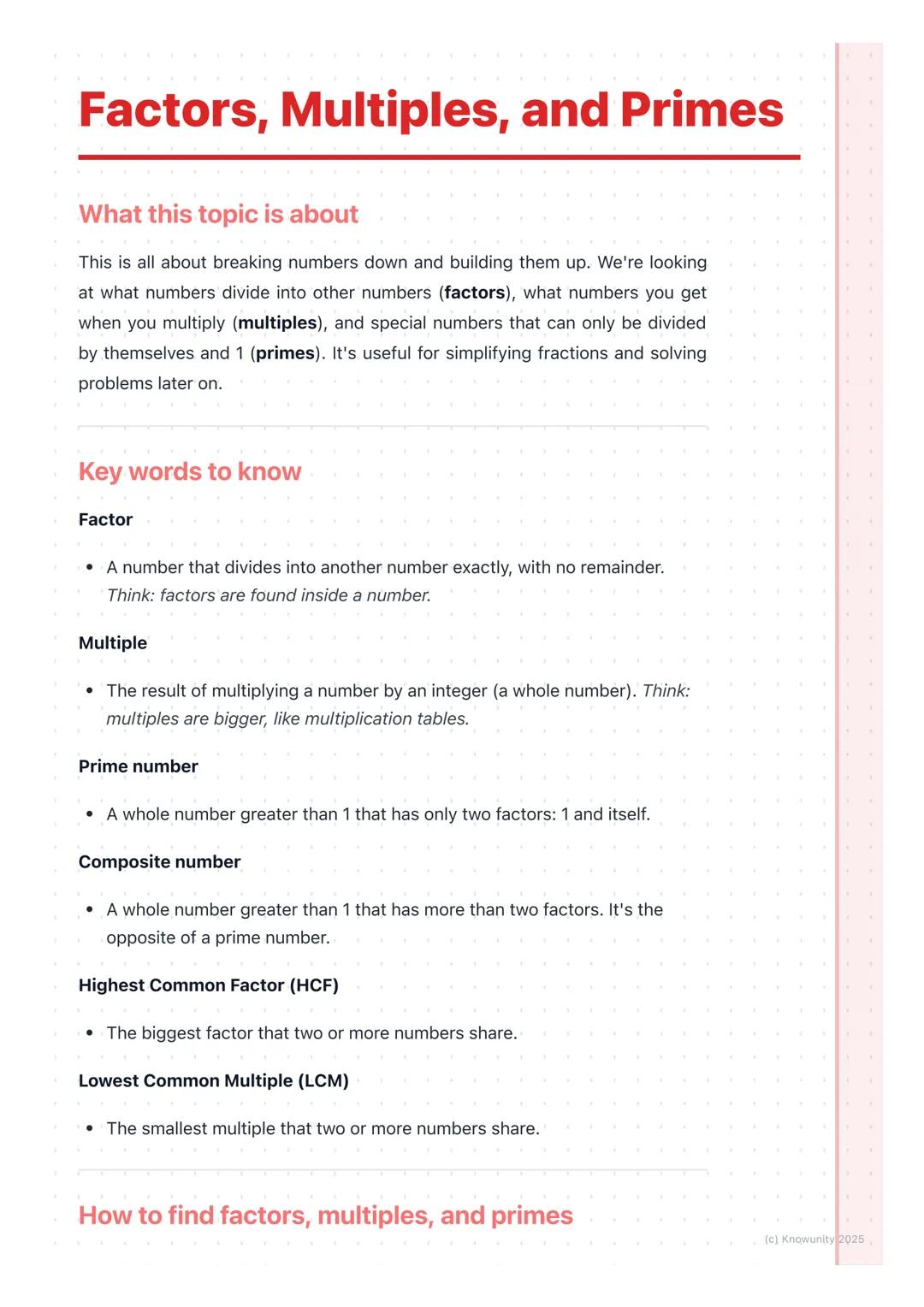
Understanding the Key Terms
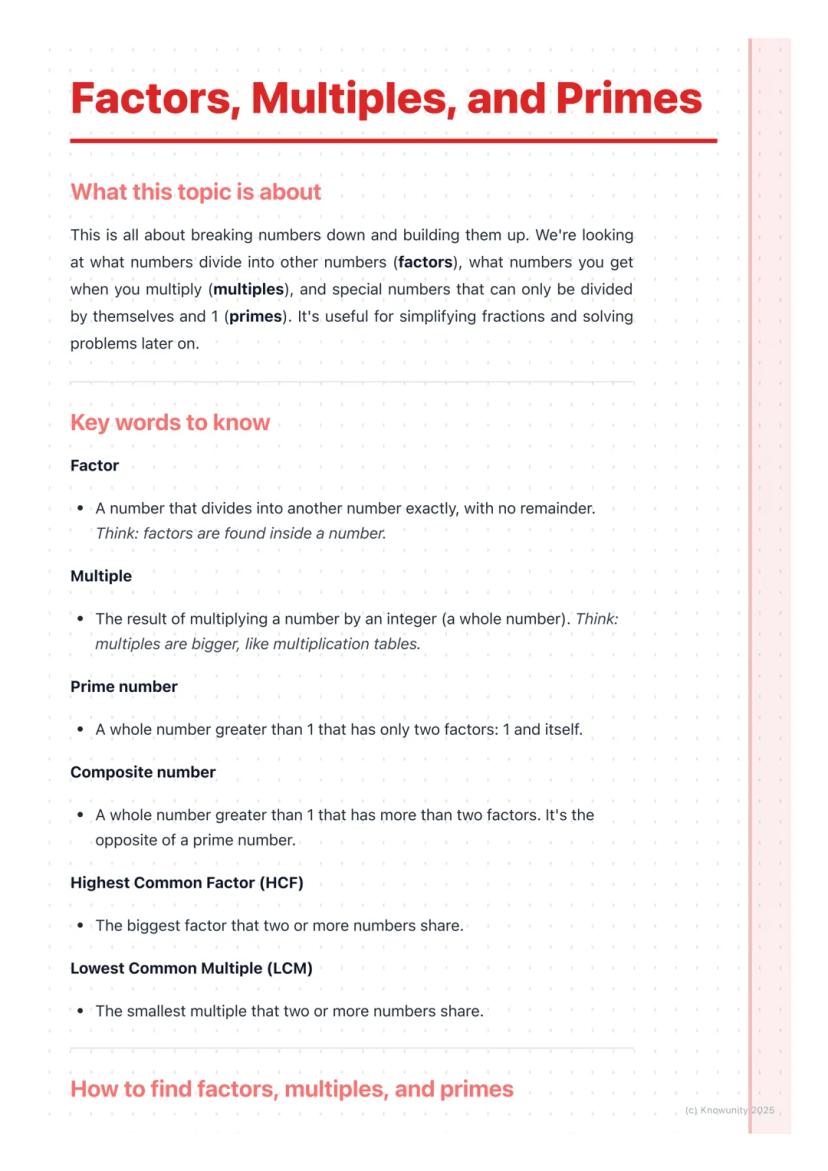
Factors are numbers that divide perfectly into another number with no remainder left over. Think of them as the building blocks hiding inside a number. When you're looking for factors, you're basically asking "what numbers can I multiply together to get this number?"
Multiples work the opposite way - they're what you get when you multiply a number by whole numbers like 1, 2, 3, and so on. It's just like reciting times tables! Multiples keep getting bigger and go on forever.
Prime numbers are the special ones that only have exactly two factors: 1 and themselves. They're like the VIPs of the number world because they can't be broken down any further.
💡 Remember: Factors divide INTO a number, multiples come FROM multiplying a number!
2
of 5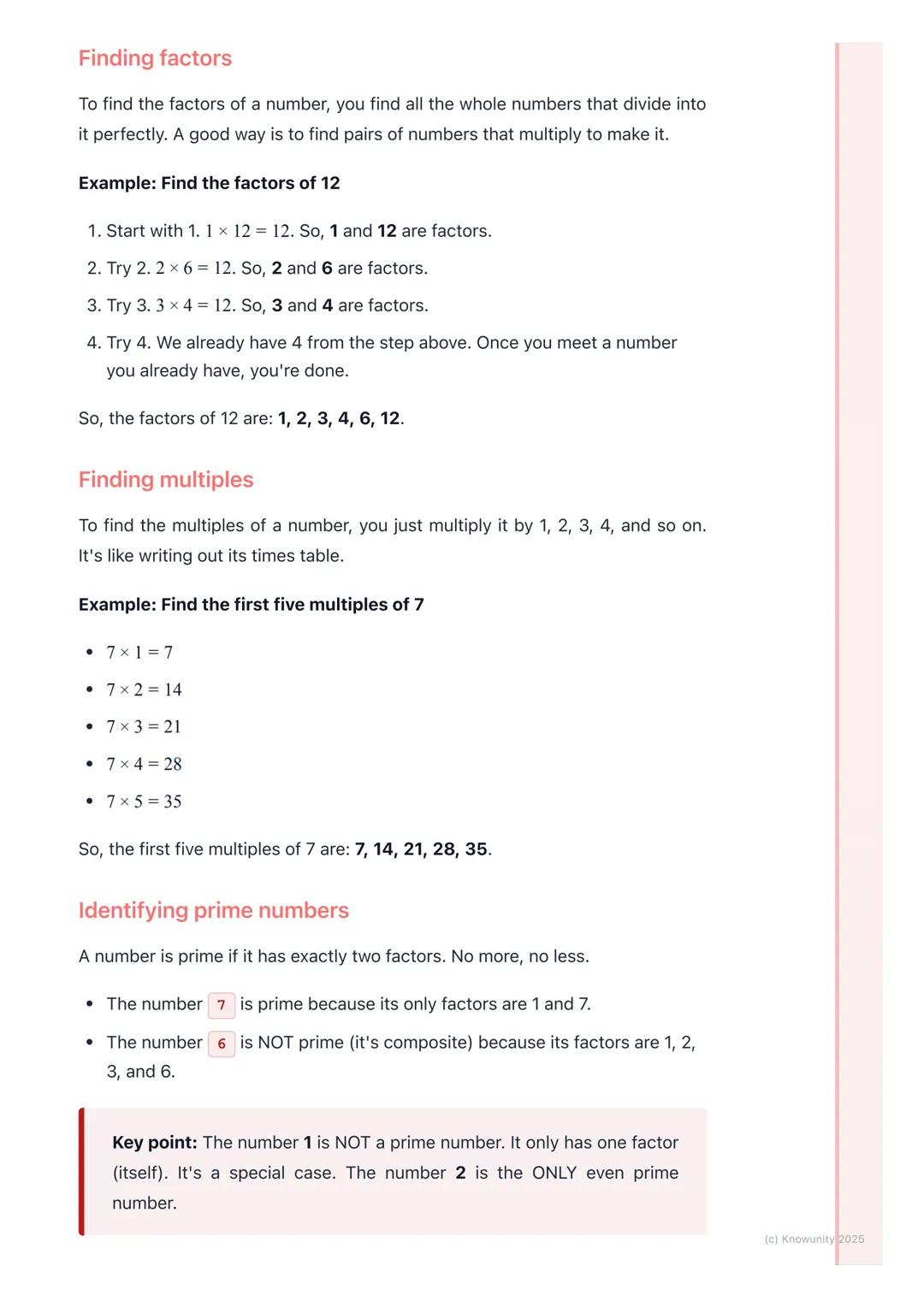
Finding Factors and Multiples
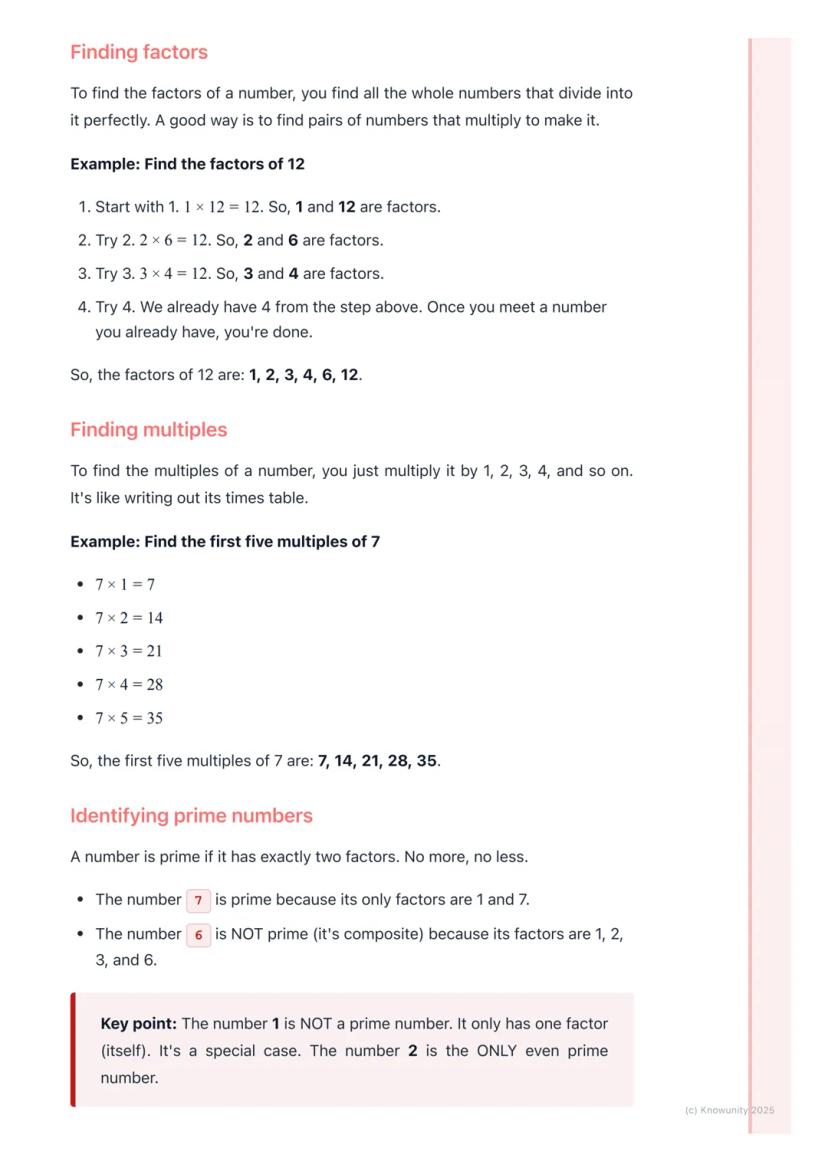
Finding factors is like detective work - you're hunting for pairs of numbers that multiply together to make your target number. Start with 1, then work your way up until you've found all the pairs. For example, with 12: you get 1×12, 2×6, and 3×4, giving you factors of 1, 2, 3, 4, 6, and 12.
Multiples are dead easy - just multiply your number by 1, 2, 3, 4, and keep going. The multiples of 7 are 7, 14, 21, 28, 35, and they continue forever.
Prime numbers have exactly two factors, no more and no less. The number 7 is prime because only 1 and 7 divide into it perfectly. Remember: 1 isn't prime (it only has one factor), and 2 is the only even prime number!
💡 Quick Check: If a number has more than two factors, it's called a composite number!
3
of 5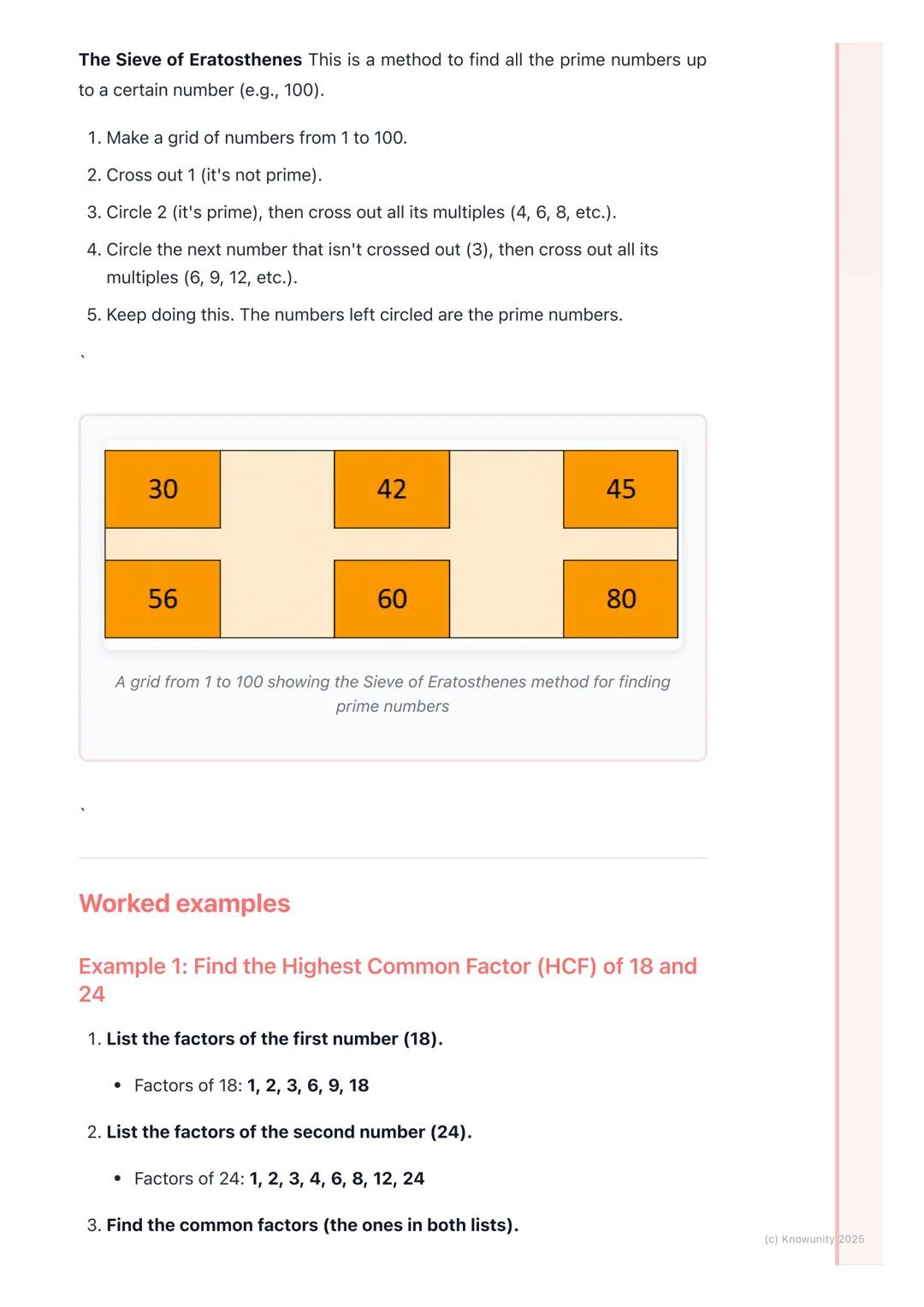
The Sieve Method and Finding HCF
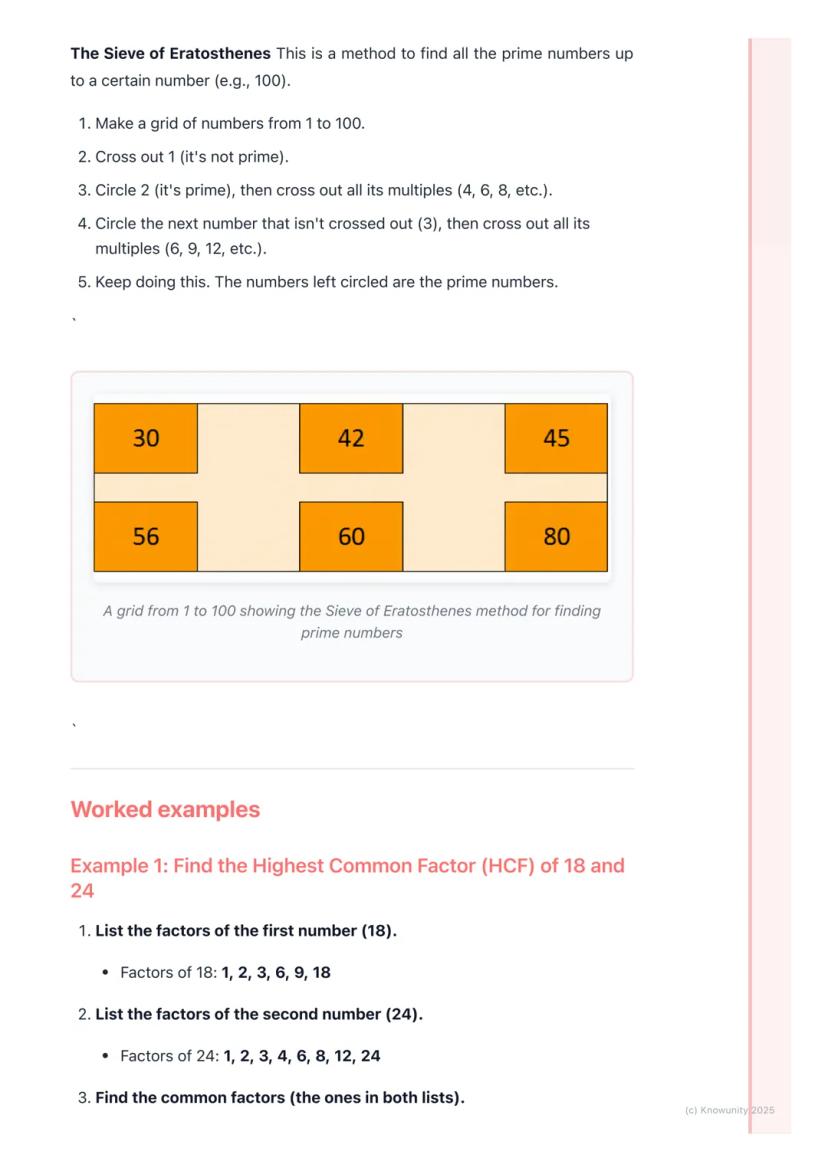
The Sieve of Eratosthenes is a brilliant way to find all prime numbers up to any limit. You start with a grid of numbers, cross out 1, then systematically eliminate multiples of each prime you find. It's like a mathematical sieve that lets only the primes fall through!
Finding the Highest Common Factor (HCF) involves a simple three-step process. First, list all the factors of both numbers. Then identify which factors appear in both lists. Finally, pick the biggest one from your common factors.
For example, with 18 and 24: the factors of 18 are 1, 2, 3, 6, 9, 18, and the factors of 24 are 1, 2, 3, 4, 6, 8, 12, 24. The common factors are 1, 2, 3, 6, so the HCF is 6.
💡 Pro Tip: The HCF is always smaller than or equal to the smaller of your two numbers!
4
of 5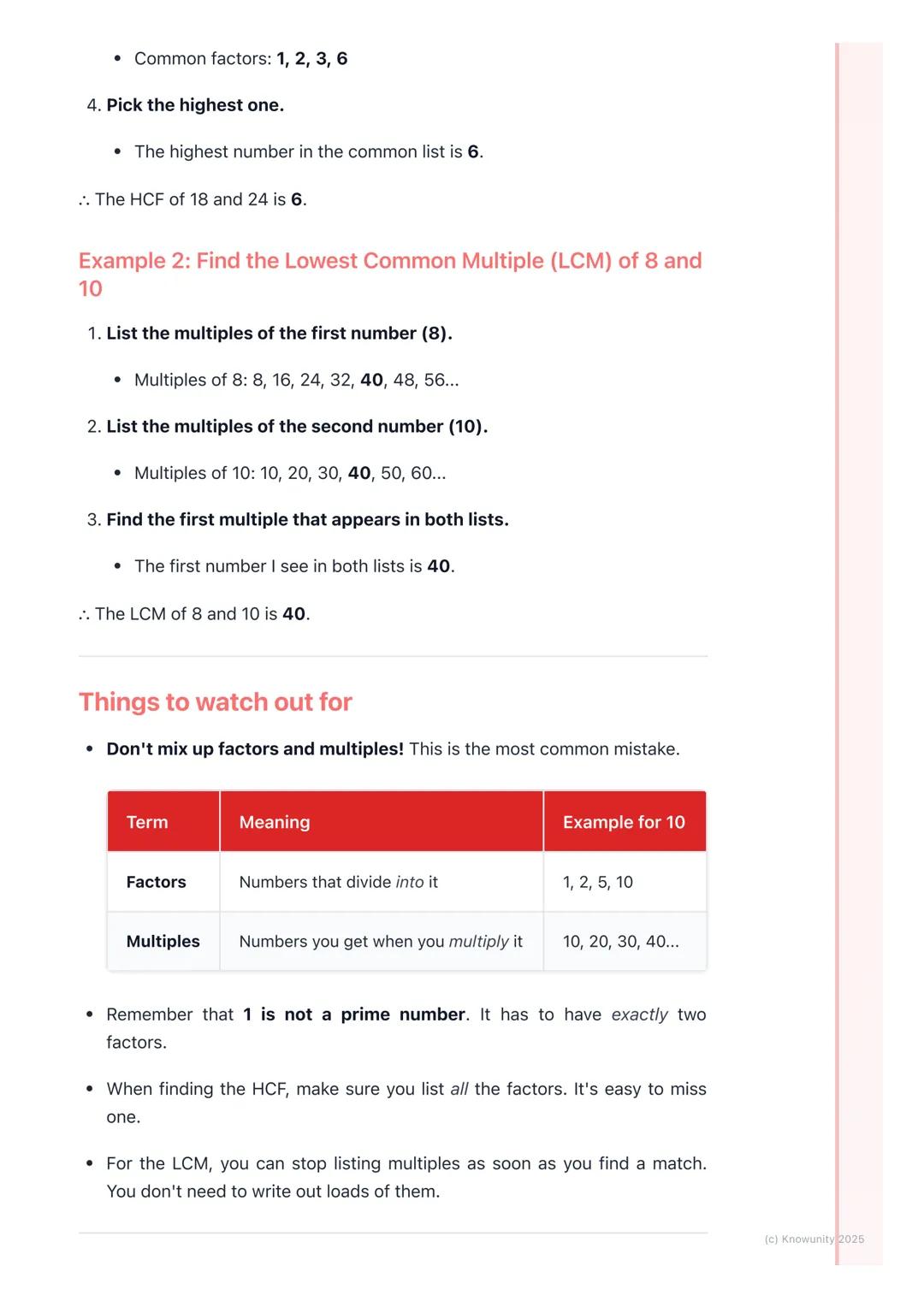
Finding LCM and Common Mistakes
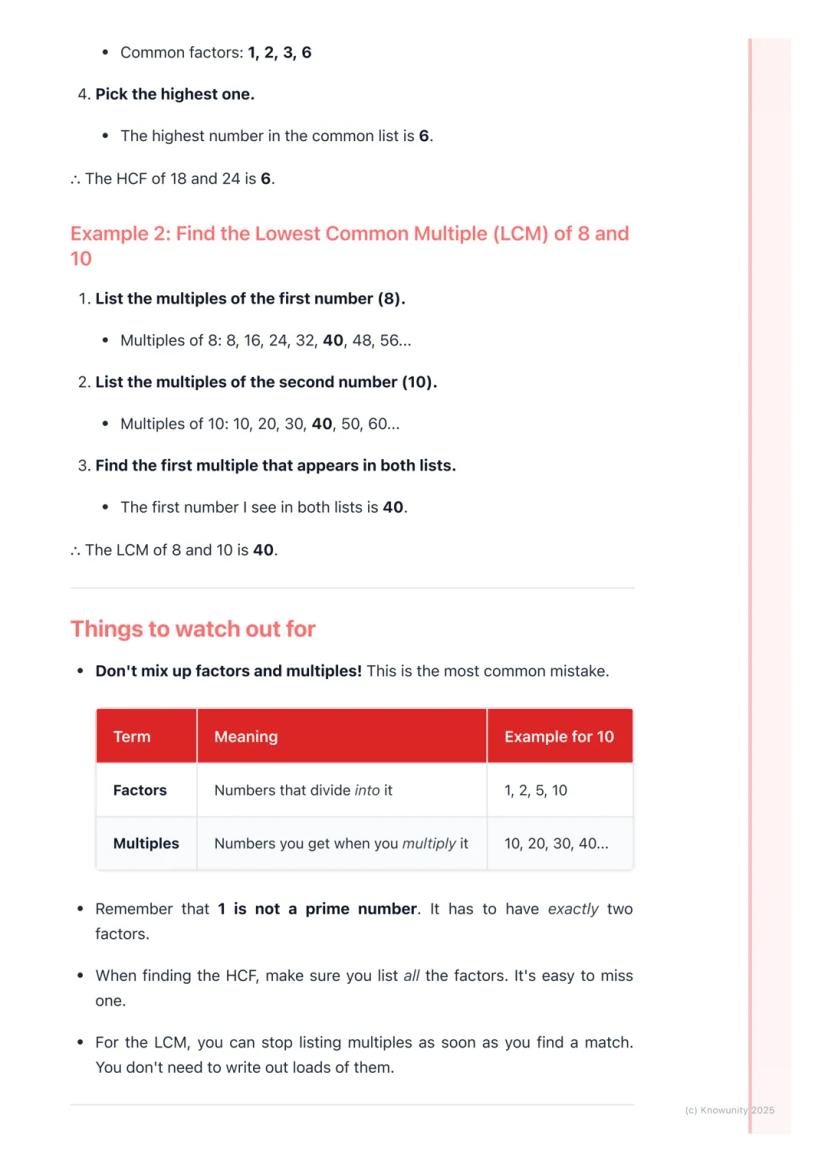
The Lowest Common Multiple (LCM) is the smallest number that both your original numbers divide into perfectly. List the multiples of each number until you spot the first one that appears in both lists. With 8 and 10: multiples of 8 are 8, 16, 24, 32, 40... and multiples of 10 are 10, 20, 30, 40... so the LCM is 40.
The biggest mistake students make is mixing up factors and multiples! Factors are the few numbers that divide INTO your number, whilst multiples are the many numbers you get FROM multiplying. Think: factors are few, multiples are many.
Another common error is forgetting that 1 isn't a prime number. Prime numbers must have exactly two factors - 1 and themselves. Also, when finding HCF, make sure you list ALL the factors, not just the obvious ones.
💡 Memory Trick: HCF goes down (finding the highest factor), LCM goes up (finding the lowest multiple)!
5
of 5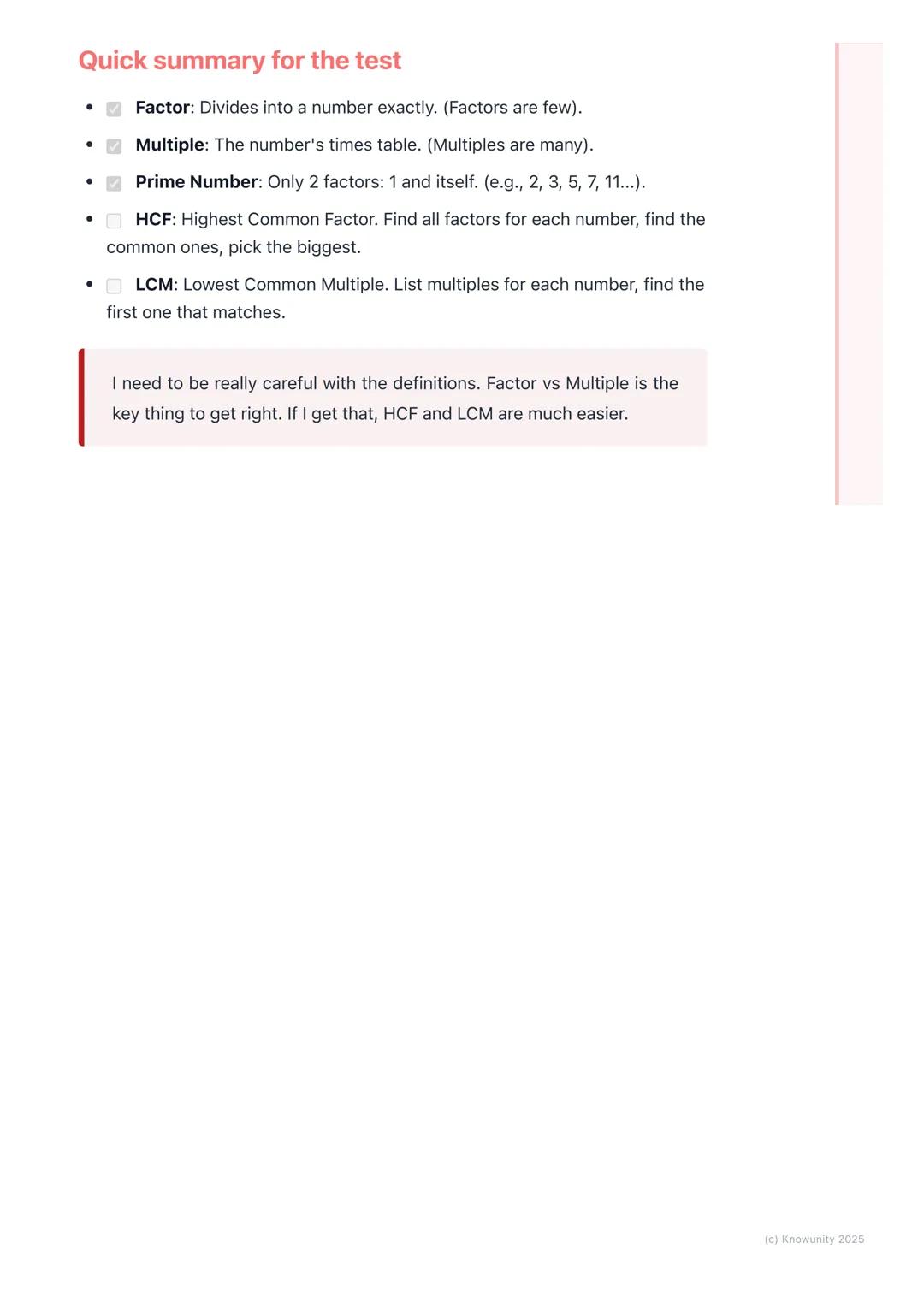
Quick Test Summary
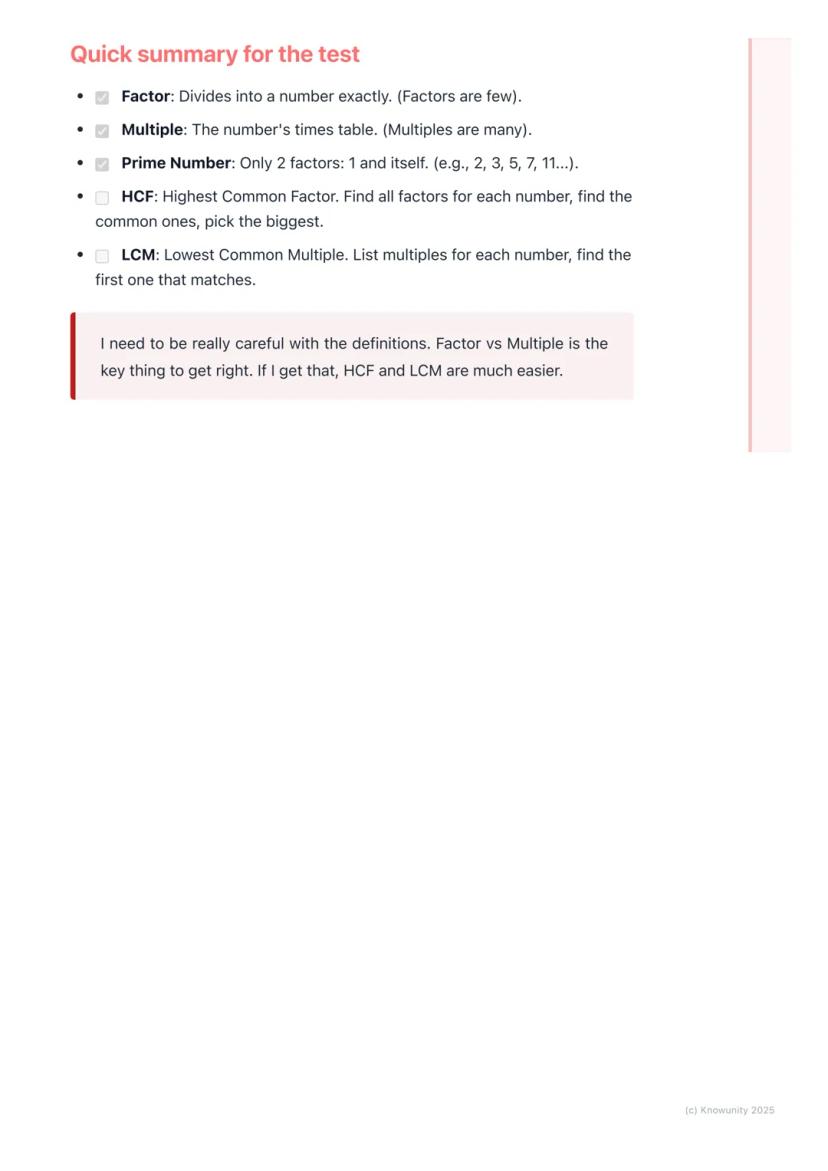
You've got the tools to tackle any factors, multiples, and primes question now! Factors divide into numbers exactly, multiples come from times tables, and prime numbers only have two factors: 1 and themselves.
For HCF, list all factors for each number, spot the common ones, then pick the biggest. For LCM, list multiples until you find the first match between your numbers.
The key to success is not mixing up factors and multiples - get this right and everything else falls into place. Remember that factors are the building blocks inside numbers, whilst multiples are what you build by multiplying outwards.
💡 Test Success: Practice identifying whether you need factors or multiples first - then the rest becomes straightforward!
Mislili smo, da nikoli ne boš vprašal...
Kaj je Knowunity AI spremljevalec?
Naš AI Spremljevalec je orodje umetne inteligence, osredotočeno na dijake, ki ponuja več kot le odgovore. Zgrajen na milijonih virov Knowunity-ja, zagotavlja relevantne informacije, prilagojene načrte učenja, kvize in vsebino neposredno v klepetu ter se prilagaja tvoji individualni poti učenja.
Kje lahko prenesem aplikacijo Knowunity?
Aplikacijo lahko preneseš iz Google Play Store ali Apple App Store.
Je Knowunity res brezplačen?
Tako je! Uživaj v brezplačnem dostopu do učnih vsebin, se povezuj s sošolci in dobi takojšnjo pomoč – vse na dosegu roke.
Najbolj priljubljena vsebina pri Mathematics
8MathematicsAlgebra
Algebra
5th Year91
MathematicsAlgebra 2
Algebra notes focusing on the factor theorem, completing the square, -b formula, graphs of polynomials
5th Year130
MathematicsSolving Equations
This section focuses on solving one-step and two-step linear equations to find the value of an unknown variable.
1st Year131
MathematicsArithmetic sequences and series
With examples
5th Year130
MathematicsIntroduction to Probability
This topic introduces basic probability concepts, including calculating the probability of simple events and understanding the difference between experimental and theoretical probability.
2nd Year91
MathematicsMaths jc algebra
Maths jc
1st Year230
MathematicsNatural Numbers and Integers
Students will learn about positive whole numbers, zero, and negative whole numbers, and how to add, subtract, multiply, and divide them correctly.
1st Year131
MathematicsDifferential Calculus
Calculus is a topic that comes up nearly everywhere on your maths LC. This is just starter notes that could be useful end of 5th year or start of 6th year
5th Year271
Najbolj priljubljena vsebina
9 Irish
IrishIrish oral questions and answers
Questions and answers for the leaving cert oral
5th Year4264
 English
Key Quotes : Sive
Key Quotes and explanations: Sive
6th Year2842
IrishIrish oral questions
Outline of oral questions
5th Year2055
IrishIníon- le hÁine Durkin
Aine Durkin’s poem, Iníon: Themes & summary
5th Year850
IrishIrish poetry 2027
Iníon + Dínit an Bhróin
5th Year1133
IrishLC HL notes- Iníon (poem)
Includes poem in English and Irish, theme, key words & phrases
5th Year2284
EnglishCultural Context : Shawshank Redemption : Sive : Small Things Like These
Comparative Study : Cultural Context : Shawshank Redemption, Sive and Small Things Like These
6th Year1430
IrishMo Ghrá-sa (Idir Lúibíní)
Notes on mo ghrá-sa
5th Year380
IrishAn Gaeilge Aiste
Irish Language essay
6th Year1320
Ne najdeš tistega, kar iščeš? Razišči druge predmete.
Dijaki nas obožujejo — in tudi ti boš.
4.6/5App Store
4.7/5Google Play
Aplikacija je res enostavna za uporabo in dobro oblikovana. Našel sem vse, kar sem iskal, in se iz predstavitev ogromno naučil! Aplikacijo bom zagotovo uporabil za razredno nalogo! In seveda mi je tudi super vir navdiha.
Stefan SiOS uporabnik
Ta aplikacija je res kul. Toliko zapiskov za učenje in pomoči [...]. Moj problemski predmet je na primer francoščina, in aplikacija ima toliko možnosti za pomoč. Zahvaljujoč tej aplikaciji sem izboljšal svojo francoščino. Priporočil bi jo vsem.
Samantha KlichAndroid uporabnica
Vau, res sem navdušena. Aplikacijo sem preizkusila, ker sem jo videla oglaševano večkrat, in sem bila popolnoma presenečena. Ta aplikacija je POMOČ, ki jo rabiš za šolo, in ponuja toliko stvari, kot so vaje in povzetki, ki so bili meni osebno ZELO koristni.
AnnaiOS uporabnica
Mathematics2 ogledi·Posodobljeno Jun 8, 2026·5 straniUnderstanding Factors, Multiples, and Prime Numbers
Numbers can be broken down and built up in fascinating ways that'll help you tackle fractions and solve complex maths problems. Understanding factors, multiples, and prime numbers is like having a mathematical toolkit that makes everything else easier.
1
of 5
Registriraj se za ogled vsebine. Brezplačno je!
- Dostop do vseh dokumentov
- Izboljšaj svoje ocene
- Pridruži se milijonom študentov
Understanding the Key Terms
Factors are numbers that divide perfectly into another number with no remainder left over. Think of them as the building blocks hiding inside a number. When you're looking for factors, you're basically asking "what numbers can I multiply together to get this number?"
Multiples work the opposite way - they're what you get when you multiply a number by whole numbers like 1, 2, 3, and so on. It's just like reciting times tables! Multiples keep getting bigger and go on forever.
Prime numbers are the special ones that only have exactly two factors: 1 and themselves. They're like the VIPs of the number world because they can't be broken down any further.
💡 Remember: Factors divide INTO a number, multiples come FROM multiplying a number!
2
of 5Registriraj se za ogled vsebine. Brezplačno je!
- Dostop do vseh dokumentov
- Izboljšaj svoje ocene
- Pridruži se milijonom študentov
Finding Factors and Multiples
Finding factors is like detective work - you're hunting for pairs of numbers that multiply together to make your target number. Start with 1, then work your way up until you've found all the pairs. For example, with 12: you get 1×12, 2×6, and 3×4, giving you factors of 1, 2, 3, 4, 6, and 12.
Multiples are dead easy - just multiply your number by 1, 2, 3, 4, and keep going. The multiples of 7 are 7, 14, 21, 28, 35, and they continue forever.
Prime numbers have exactly two factors, no more and no less. The number 7 is prime because only 1 and 7 divide into it perfectly. Remember: 1 isn't prime (it only has one factor), and 2 is the only even prime number!
💡 Quick Check: If a number has more than two factors, it's called a composite number!
3
of 5Registriraj se za ogled vsebine. Brezplačno je!
- Dostop do vseh dokumentov
- Izboljšaj svoje ocene
- Pridruži se milijonom študentov
The Sieve Method and Finding HCF
The Sieve of Eratosthenes is a brilliant way to find all prime numbers up to any limit. You start with a grid of numbers, cross out 1, then systematically eliminate multiples of each prime you find. It's like a mathematical sieve that lets only the primes fall through!
Finding the Highest Common Factor (HCF) involves a simple three-step process. First, list all the factors of both numbers. Then identify which factors appear in both lists. Finally, pick the biggest one from your common factors.
For example, with 18 and 24: the factors of 18 are 1, 2, 3, 6, 9, 18, and the factors of 24 are 1, 2, 3, 4, 6, 8, 12, 24. The common factors are 1, 2, 3, 6, so the HCF is 6.
💡 Pro Tip: The HCF is always smaller than or equal to the smaller of your two numbers!
4
of 5Registriraj se za ogled vsebine. Brezplačno je!
- Dostop do vseh dokumentov
- Izboljšaj svoje ocene
- Pridruži se milijonom študentov
Finding LCM and Common Mistakes
The Lowest Common Multiple (LCM) is the smallest number that both your original numbers divide into perfectly. List the multiples of each number until you spot the first one that appears in both lists. With 8 and 10: multiples of 8 are 8, 16, 24, 32, 40... and multiples of 10 are 10, 20, 30, 40... so the LCM is 40.
The biggest mistake students make is mixing up factors and multiples! Factors are the few numbers that divide INTO your number, whilst multiples are the many numbers you get FROM multiplying. Think: factors are few, multiples are many.
Another common error is forgetting that 1 isn't a prime number. Prime numbers must have exactly two factors - 1 and themselves. Also, when finding HCF, make sure you list ALL the factors, not just the obvious ones.
💡 Memory Trick: HCF goes down (finding the highest factor), LCM goes up (finding the lowest multiple)!
5
of 5Registriraj se za ogled vsebine. Brezplačno je!
- Dostop do vseh dokumentov
- Izboljšaj svoje ocene
- Pridruži se milijonom študentov
Quick Test Summary
You've got the tools to tackle any factors, multiples, and primes question now! Factors divide into numbers exactly, multiples come from times tables, and prime numbers only have two factors: 1 and themselves.
For HCF, list all factors for each number, spot the common ones, then pick the biggest. For LCM, list multiples until you find the first match between your numbers.
The key to success is not mixing up factors and multiples - get this right and everything else falls into place. Remember that factors are the building blocks inside numbers, whilst multiples are what you build by multiplying outwards.
💡 Test Success: Practice identifying whether you need factors or multiples first - then the rest becomes straightforward!
Mislili smo, da nikoli ne boš vprašal...
Kaj je Knowunity AI spremljevalec?
Naš AI Spremljevalec je orodje umetne inteligence, osredotočeno na dijake, ki ponuja več kot le odgovore. Zgrajen na milijonih virov Knowunity-ja, zagotavlja relevantne informacije, prilagojene načrte učenja, kvize in vsebino neposredno v klepetu ter se prilagaja tvoji individualni poti učenja.
Kje lahko prenesem aplikacijo Knowunity?
Aplikacijo lahko preneseš iz Google Play Store ali Apple App Store.
Je Knowunity res brezplačen?
Tako je! Uživaj v brezplačnem dostopu do učnih vsebin, se povezuj s sošolci in dobi takojšnjo pomoč – vse na dosegu roke.
Najbolj priljubljena vsebina pri Mathematics
8MathematicsAlgebra
Algebra
5th Year91
MathematicsAlgebra 2
Algebra notes focusing on the factor theorem, completing the square, -b formula, graphs of polynomials
5th Year130
MathematicsSolving Equations
This section focuses on solving one-step and two-step linear equations to find the value of an unknown variable.
1st Year131
MathematicsArithmetic sequences and series
With examples
5th Year130
MathematicsIntroduction to Probability
This topic introduces basic probability concepts, including calculating the probability of simple events and understanding the difference between experimental and theoretical probability.
2nd Year91
MathematicsMaths jc algebra
Maths jc
1st Year230
MathematicsNatural Numbers and Integers
Students will learn about positive whole numbers, zero, and negative whole numbers, and how to add, subtract, multiply, and divide them correctly.
1st Year131
MathematicsDifferential Calculus
Calculus is a topic that comes up nearly everywhere on your maths LC. This is just starter notes that could be useful end of 5th year or start of 6th year
5th Year271
Najbolj priljubljena vsebina
9IrishIrish oral questions and answers
Questions and answers for the leaving cert oral
5th Year4264
EnglishKey Quotes : Sive
Key Quotes and explanations: Sive
6th Year2842
IrishIrish oral questions
Outline of oral questions
5th Year2055
IrishIníon- le hÁine Durkin
Aine Durkin’s poem, Iníon: Themes & summary
5th Year850
IrishIrish poetry 2027
Iníon + Dínit an Bhróin
5th Year1133
IrishLC HL notes- Iníon (poem)
Includes poem in English and Irish, theme, key words & phrases
5th Year2284
EnglishCultural Context : Shawshank Redemption : Sive : Small Things Like These
Comparative Study : Cultural Context : Shawshank Redemption, Sive and Small Things Like These
6th Year1430
IrishMo Ghrá-sa (Idir Lúibíní)
Notes on mo ghrá-sa
5th Year380
IrishAn Gaeilge Aiste
Irish Language essay
6th Year1320
Ne najdeš tistega, kar iščeš? Razišči druge predmete.
Dijaki nas obožujejo — in tudi ti boš.
4.6/5App Store
4.7/5Google Play
Aplikacija je res enostavna za uporabo in dobro oblikovana. Našel sem vse, kar sem iskal, in se iz predstavitev ogromno naučil! Aplikacijo bom zagotovo uporabil za razredno nalogo! In seveda mi je tudi super vir navdiha.
Stefan SiOS uporabnik
Ta aplikacija je res kul. Toliko zapiskov za učenje in pomoči [...]. Moj problemski predmet je na primer francoščina, in aplikacija ima toliko možnosti za pomoč. Zahvaljujoč tej aplikaciji sem izboljšal svojo francoščino. Priporočil bi jo vsem.
Samantha KlichAndroid uporabnica
Vau, res sem navdušena. Aplikacijo sem preizkusila, ker sem jo videla oglaševano večkrat, in sem bila popolnoma presenečena. Ta aplikacija je POMOČ, ki jo rabiš za šolo, in ponuja toliko stvari, kot so vaje in povzetki, ki so bili meni osebno ZELO koristni.
AnnaiOS uporabnica