
Ever wondered why a balloon shrinks in the cold or... Prikaži več
 Chemistry6 ogledi·Posodobljeno May 30, 2026·7 strani
Understanding Gas Laws: Boyle's and Charles's Principles Simplified
1 / 7
1
of 7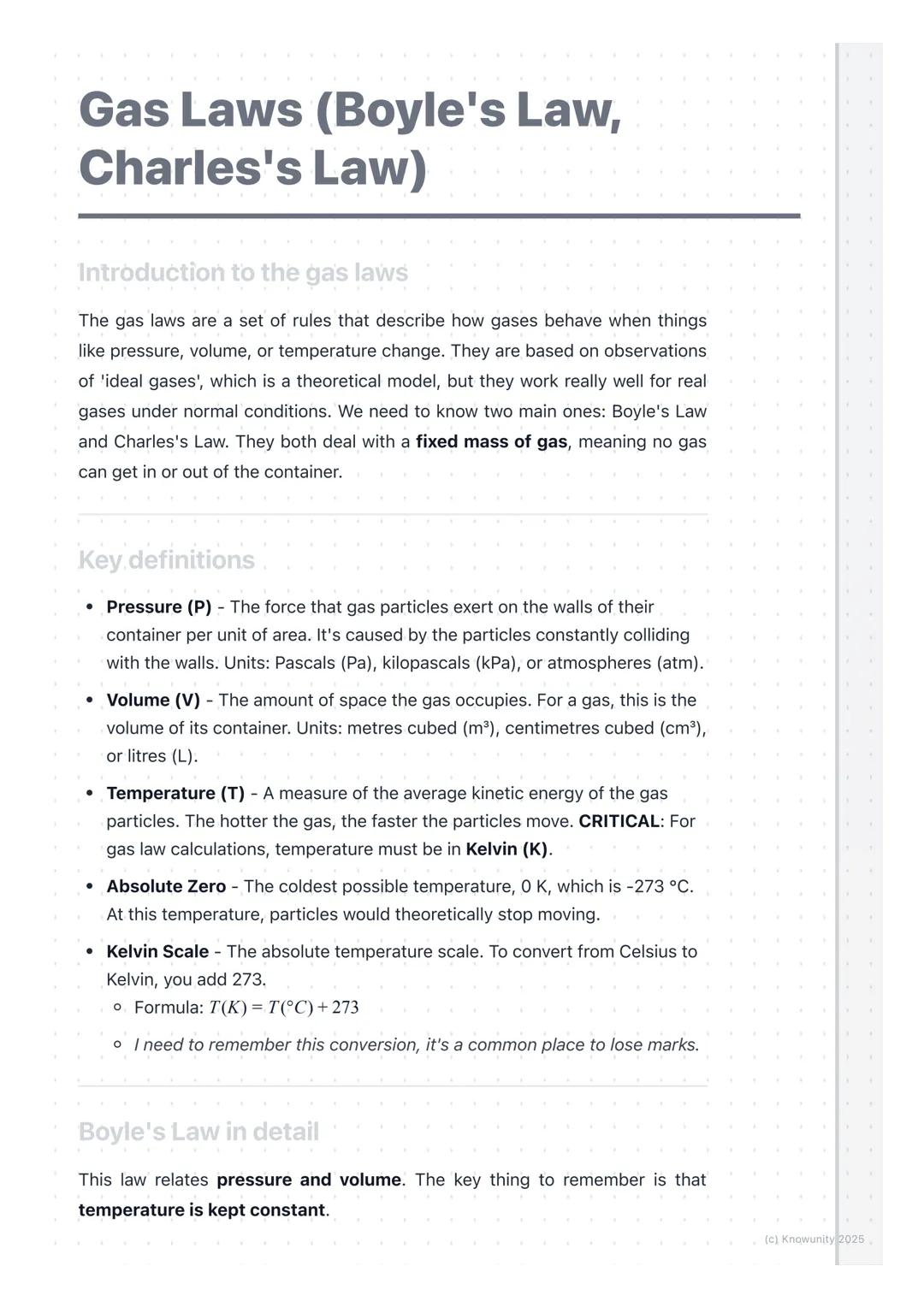
Understanding Gas Laws Basics
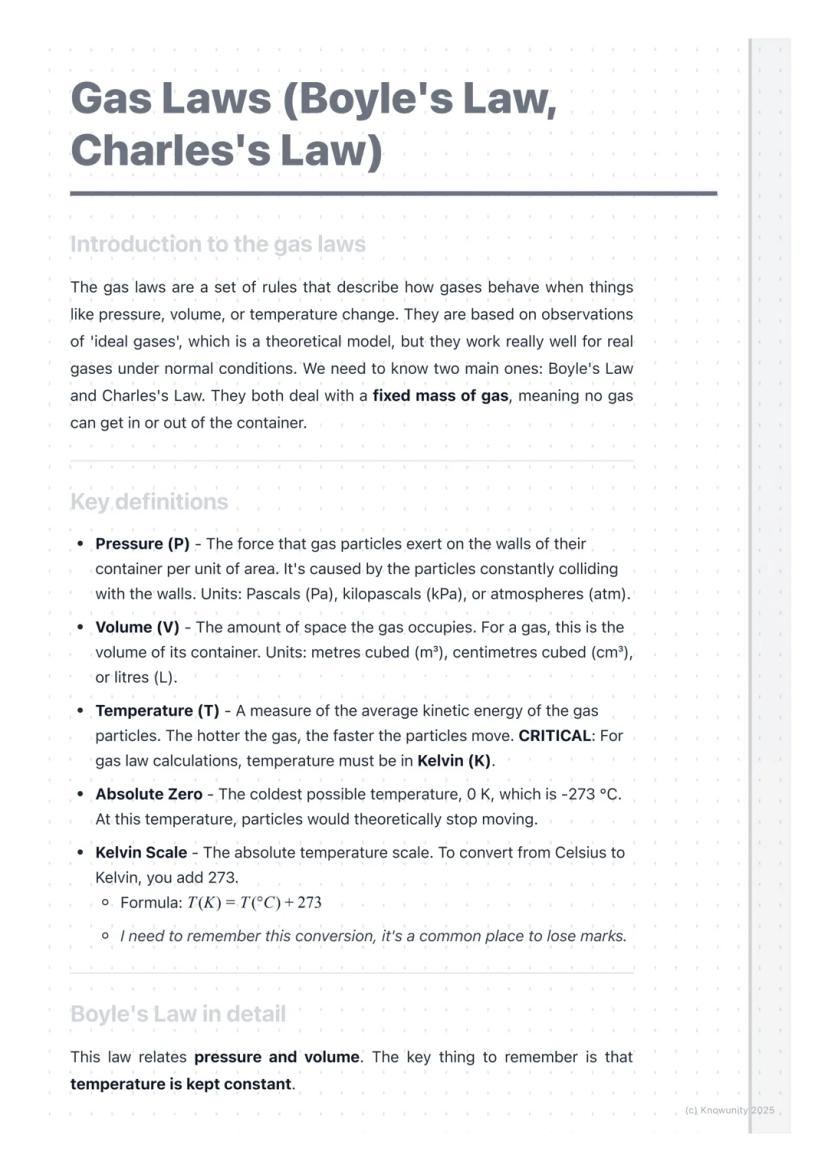
Gas laws are straightforward rules that predict how gases behave under different conditions. They're based on ideal gases - a theoretical model that works brilliantly for real gases under normal conditions.
The key thing to remember is that we're always dealing with a fixed mass of gas. This means no gas escapes or enters the container during our experiments.
You need to master some crucial definitions first. Pressure is the force gas particles exert on container walls through constant collisions. Volume is simply the space the gas occupies. Temperature measures the average kinetic energy of gas particles - faster particles mean higher temperature.
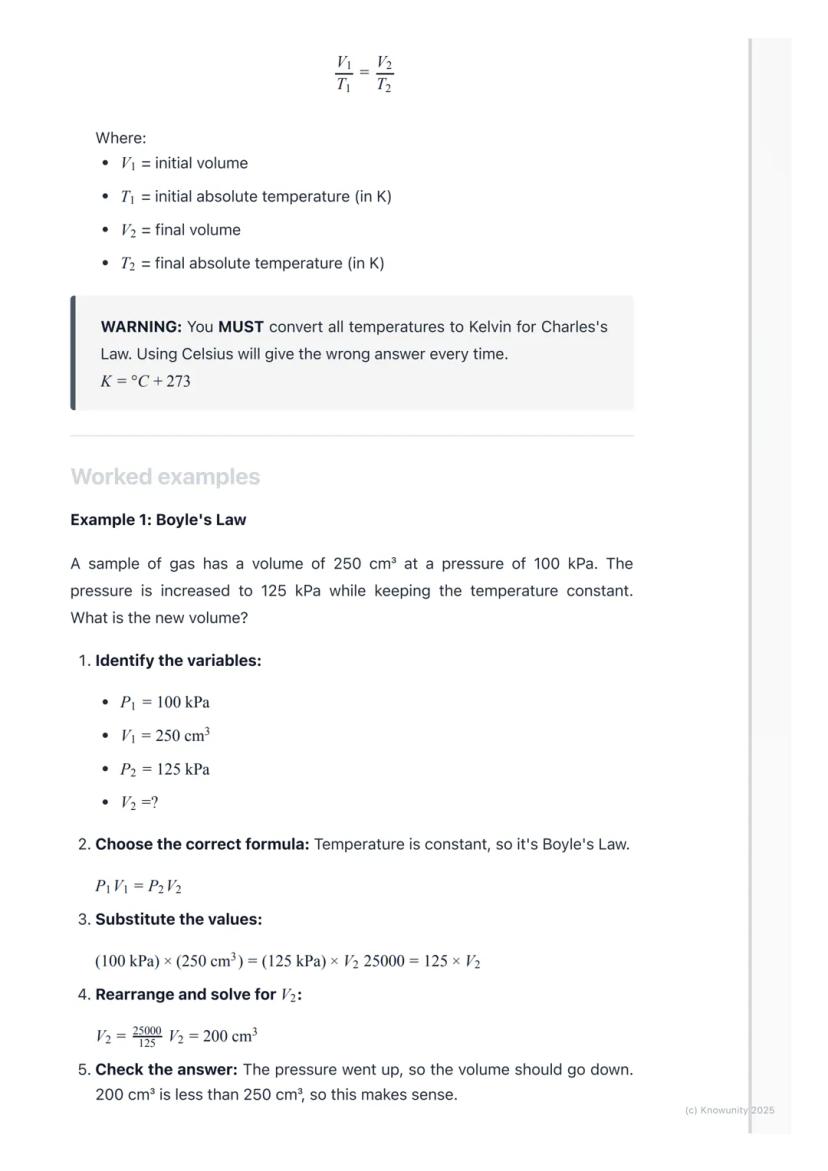
💡 Critical Point: For all gas law calculations, temperature MUST be in Kelvin. Convert by adding 273 to Celsius: K = °C + 273. This is where most students lose marks!
2
of 7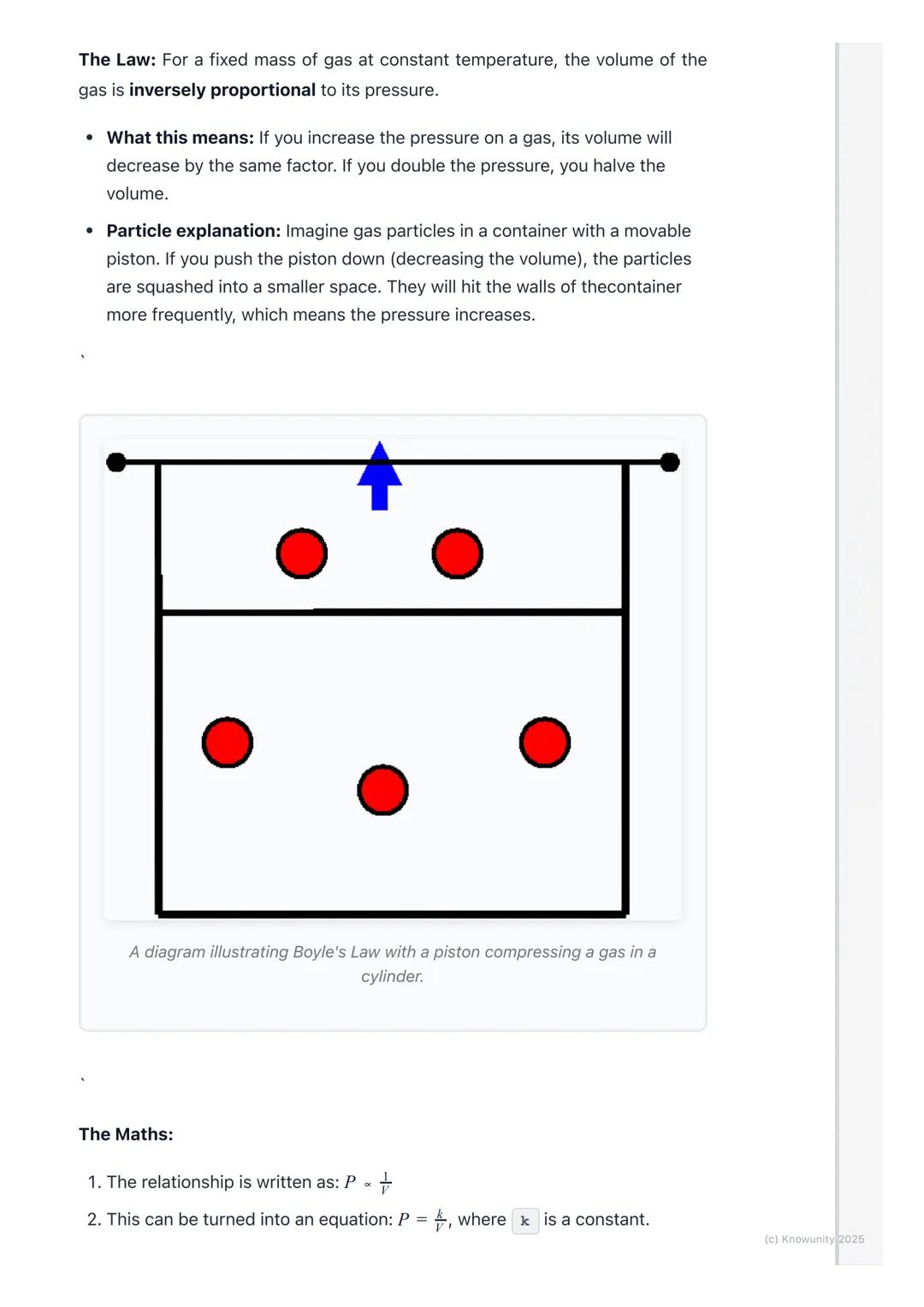
Boyle's Law - Pressure vs Volume
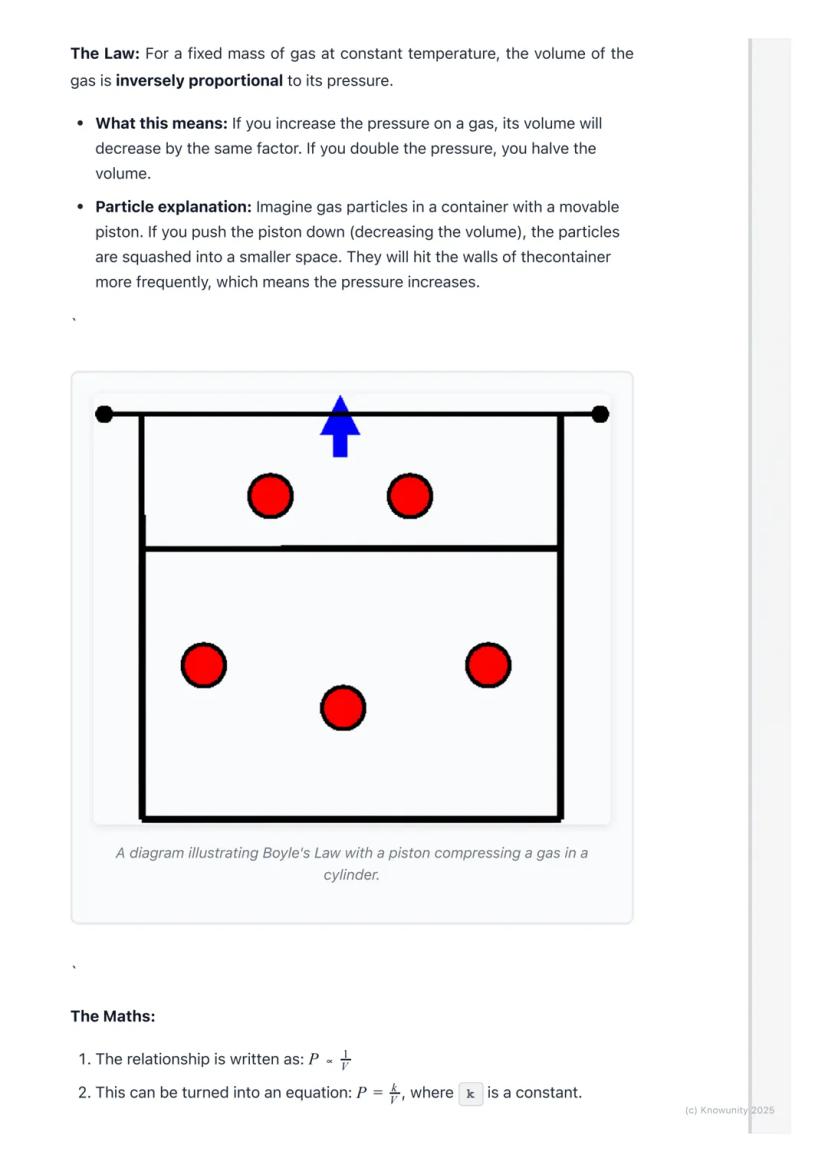
Boyle's Law is all about the relationship between pressure and volume whilst keeping temperature constant. Here's the key principle: volume is inversely proportional to pressure.
Double the pressure, and you'll halve the volume. It makes perfect sense when you think about particles - squeeze them into a smaller space (decrease volume), and they'll hit the walls more frequently, increasing pressure.
The mathematical relationship is beautifully simple: PV = constant. For calculations involving changes, use the formula: P₁V₁ = P₂V₂
Here's what's brilliant about this - your units just need to be consistent on both sides. If you start with cm³, your answer will be in cm³. No complicated conversions needed!
💡 Memory Trick: Boyle's Law = "Pressure squeezes" - higher pressure squeezes the volume smaller.
3
of 7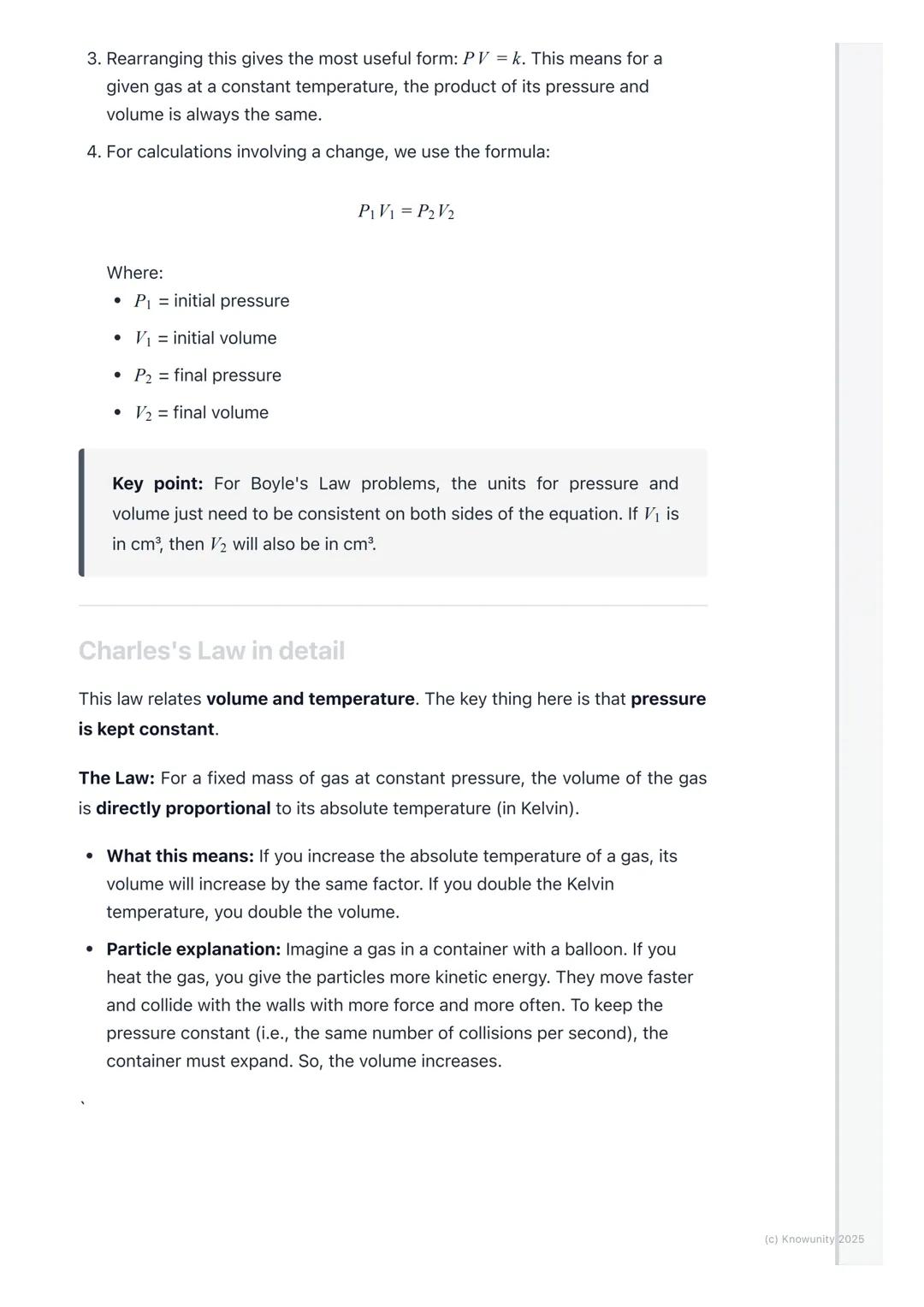
Charles's Law - Volume vs Temperature
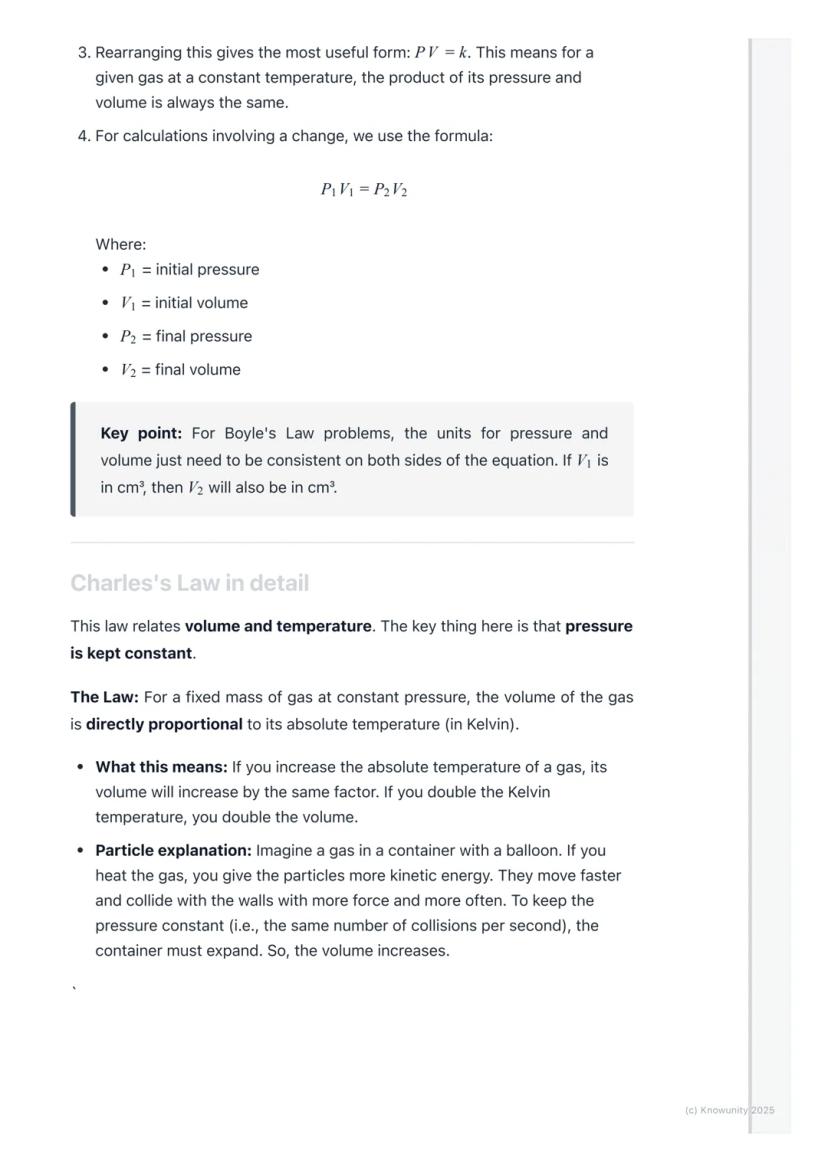
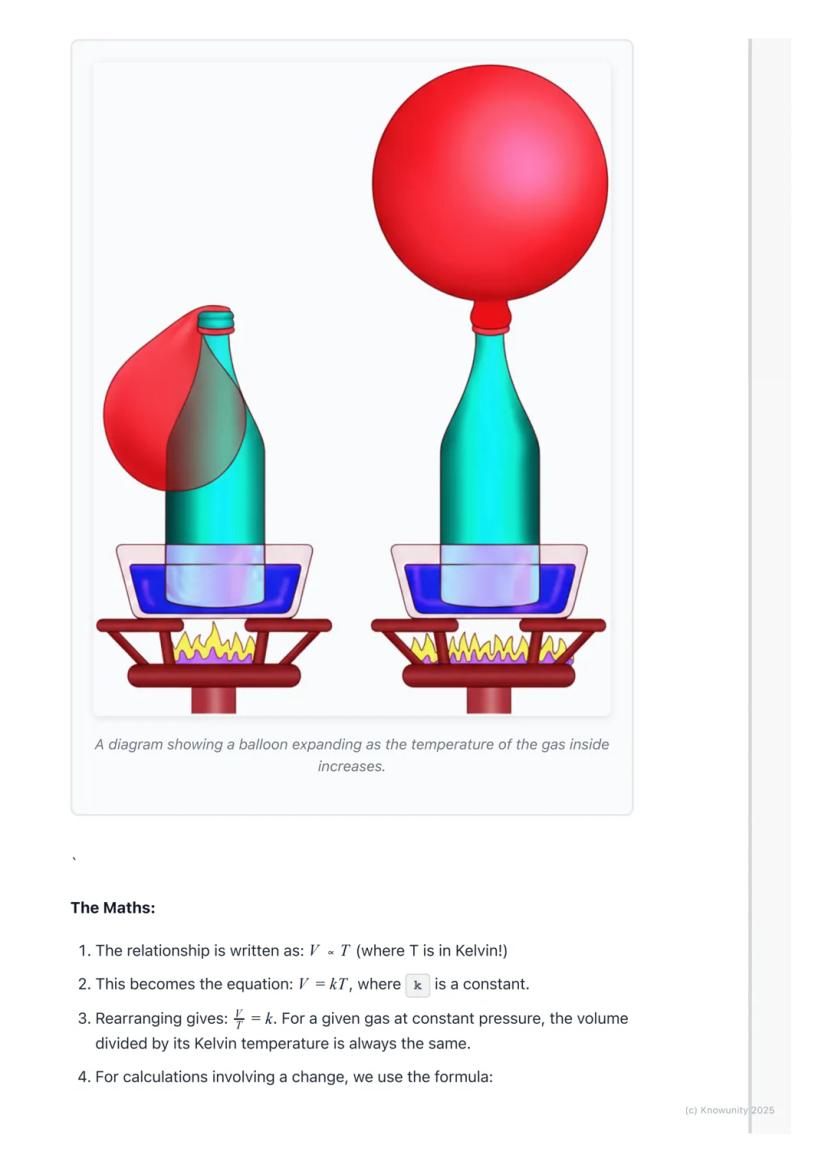
Charles's Law explores how volume changes with temperature whilst pressure stays constant. The relationship here is directly proportional - increase temperature, increase volume by the same factor.
Picture a balloon in your car on a hot day - it expands because heated gas particles move faster and need more space. The pressure stays the same, but the volume increases to accommodate the more energetic particles.
The formula for changes is: V₁/T₁ = V₂/T₂. But here's the absolute crucial bit - temperature MUST be in Kelvin. Using Celsius will guarantee the wrong answer.
Remember: K = °C + 273. Write this conversion at the start of every Charles's Law problem. It'll save you from the most common mistake in gas law questions.
💡 Warning: Never forget Kelvin conversion! It's the number one way students mess up Charles's Law calculations.
4
of 7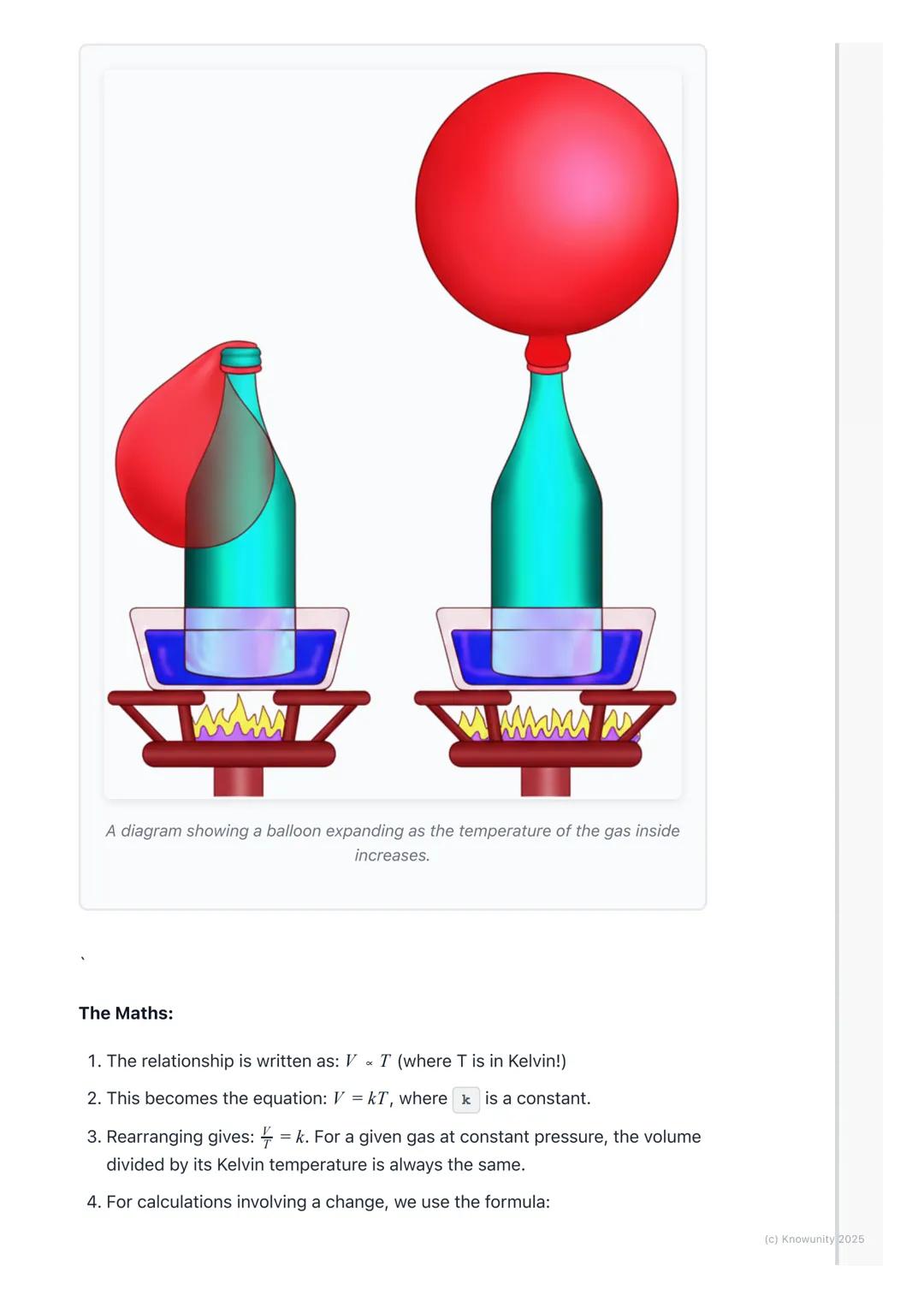
Worked Example - Boyle's Law
Let's tackle a typical exam question: A gas sample has 250 cm³ volume at 100 kPa pressure. Pressure increases to 125 kPa at constant temperature. What's the new volume?
First, identify your variables: P₁ = 100 kPa, V₁ = 250 cm³, P₂ = 125 kPa, V₂ = ?
Since temperature is constant, we use Boyle's Law: P₁V₁ = P₂V₂
Substitute: (100)(250) = (125)(V₂), so 25000 = 125V₂
Solving: V₂ = 25000 ÷ 125 = 200 cm³
Always check your answer makes sense - pressure increased, so volume should decrease. 200 cm³ is less than 250 cm³, so we're spot on!
💡 Pro Tip: Always do a sense check - if pressure goes up, volume goes down in Boyle's Law.
5
of 7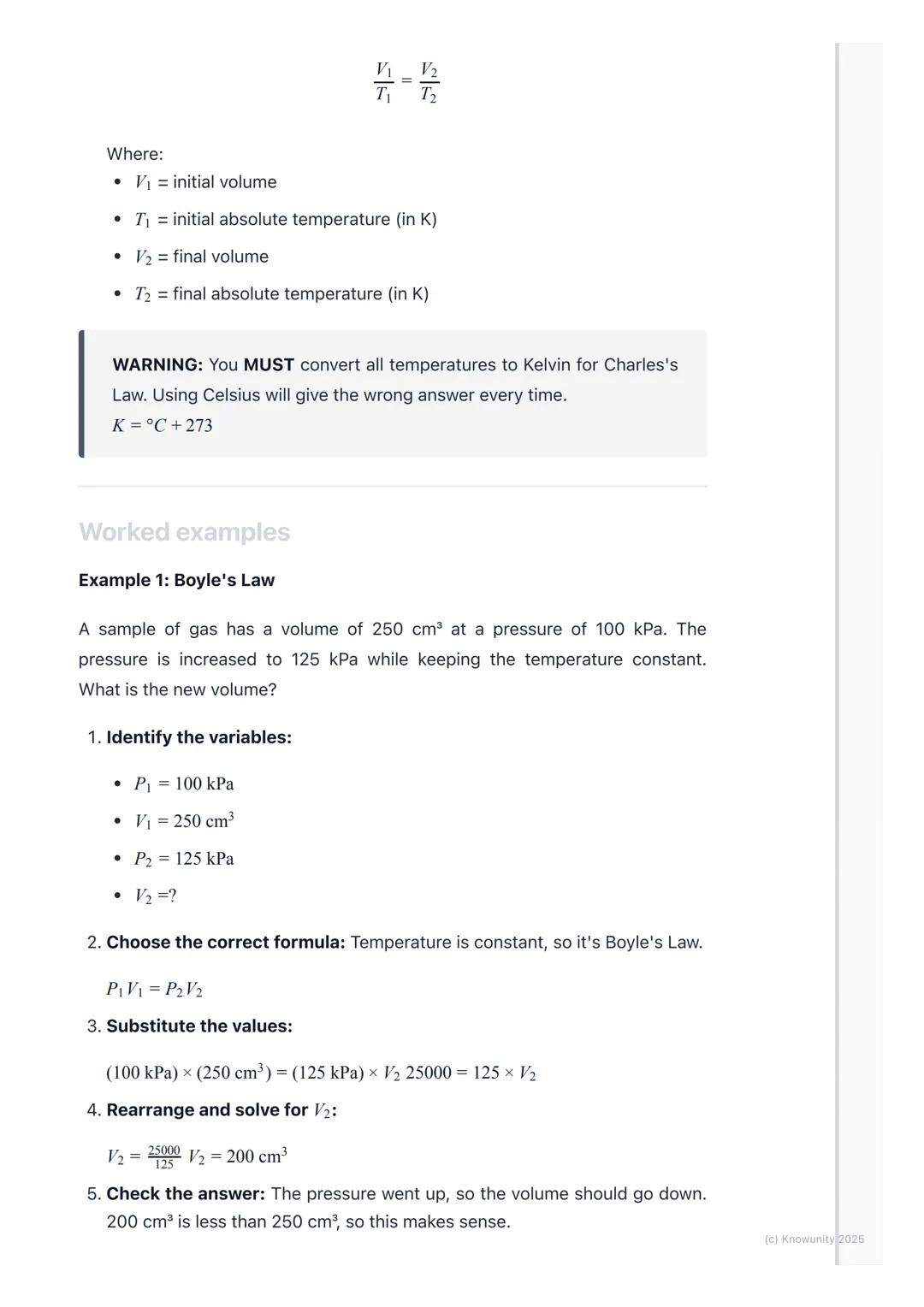
Worked Example - Charles's Law
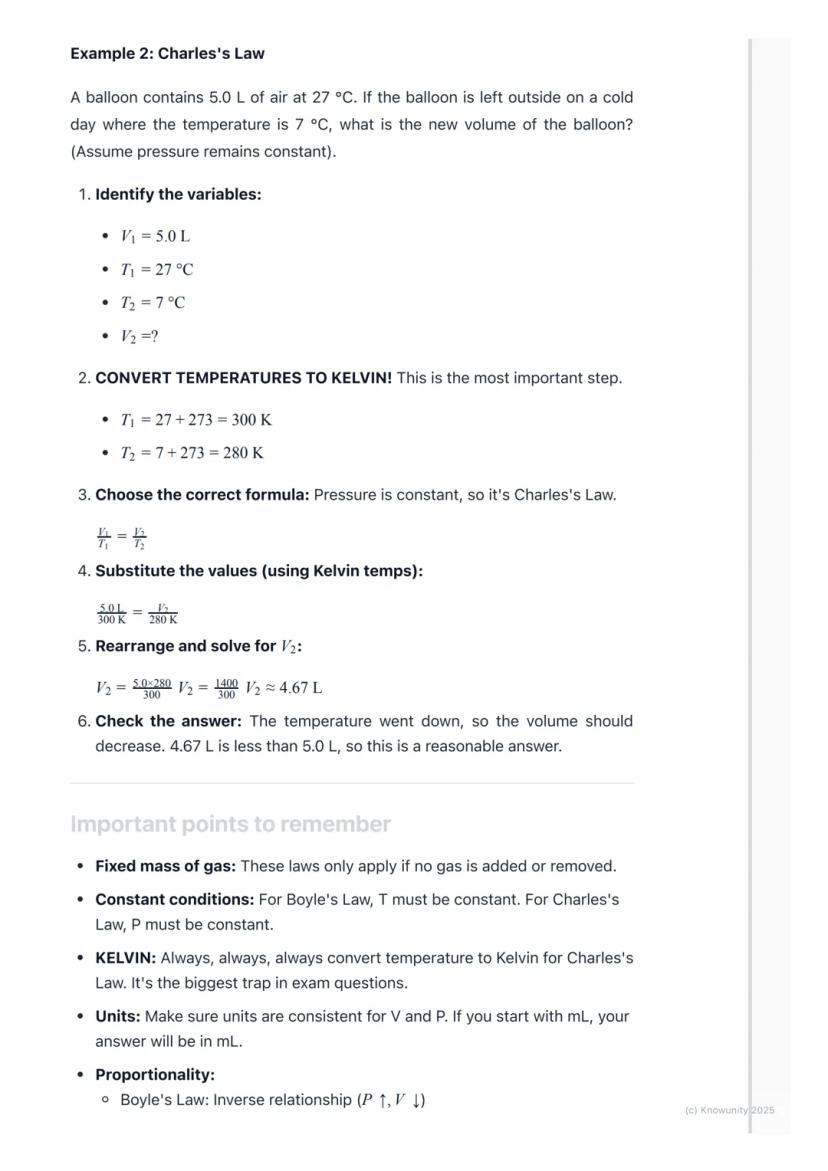
Here's a Charles's Law problem: A balloon contains 5.0 L of air at 27°C. On a cold day at 7°C, what's the new volume? (Pressure stays constant)
Step one is absolutely critical - convert to Kelvin immediately: T₁ = 27 + 273 = 300 K, T₂ = 7 + 273 = 280 K
Now identify variables: V₁ = 5.0 L, T₁ = 300 K, T₂ = 280 K, V₂ = ?
Use Charles's Law formula: V₁/T₁ = V₂/T₂
Substitute: 5.0/300 = V₂/280
Solving: V₂ = (5.0 × 280) ÷ 300 = 4.67 L
Sense check - temperature decreased, so volume should decrease. 4.67 L < 5.0 L ✓
💡 Success Strategy: Write "Convert to Kelvin!" at the top of every Charles's Law problem as a reminder.
6
of 7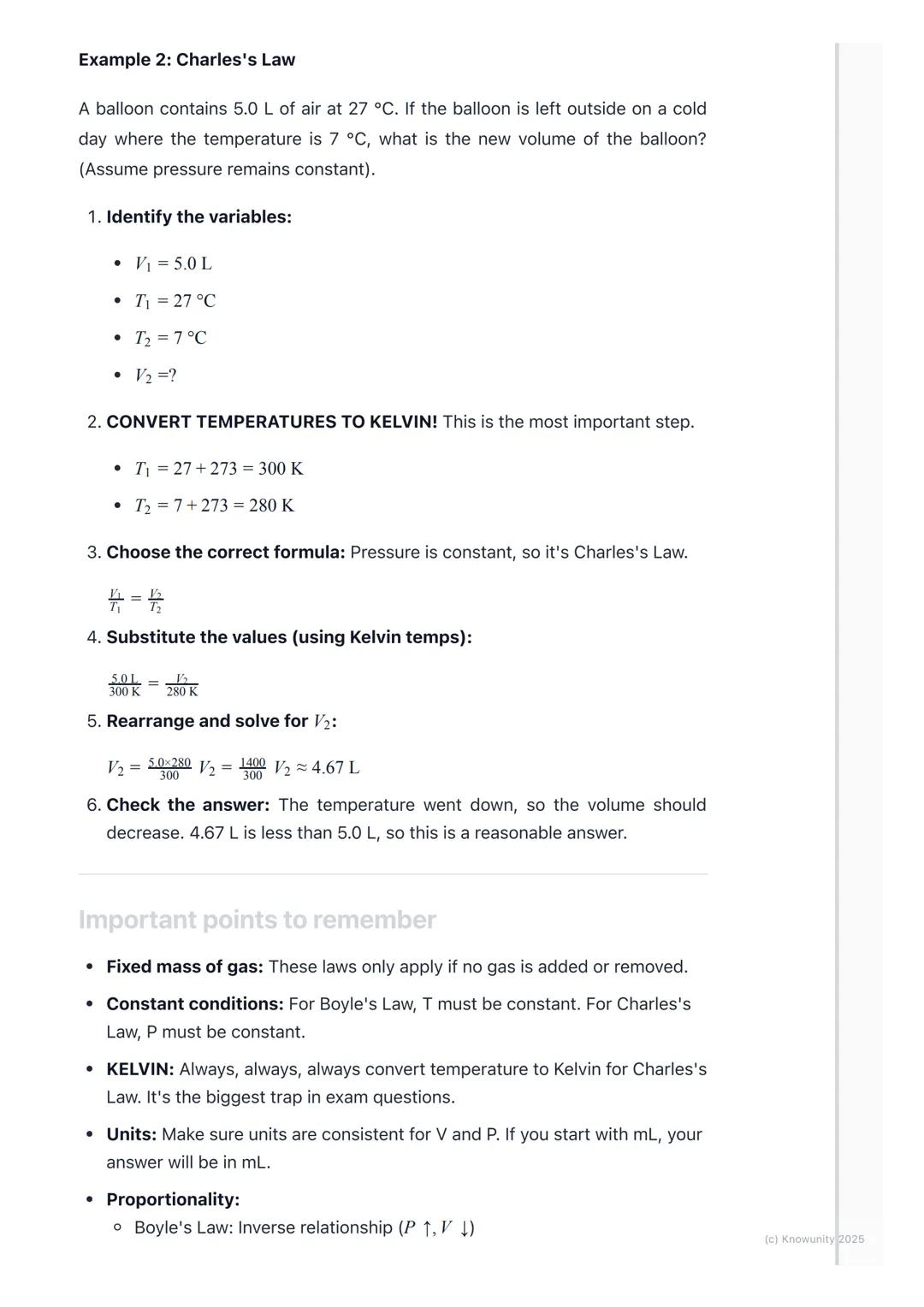
Quick Reference and Exam Tips
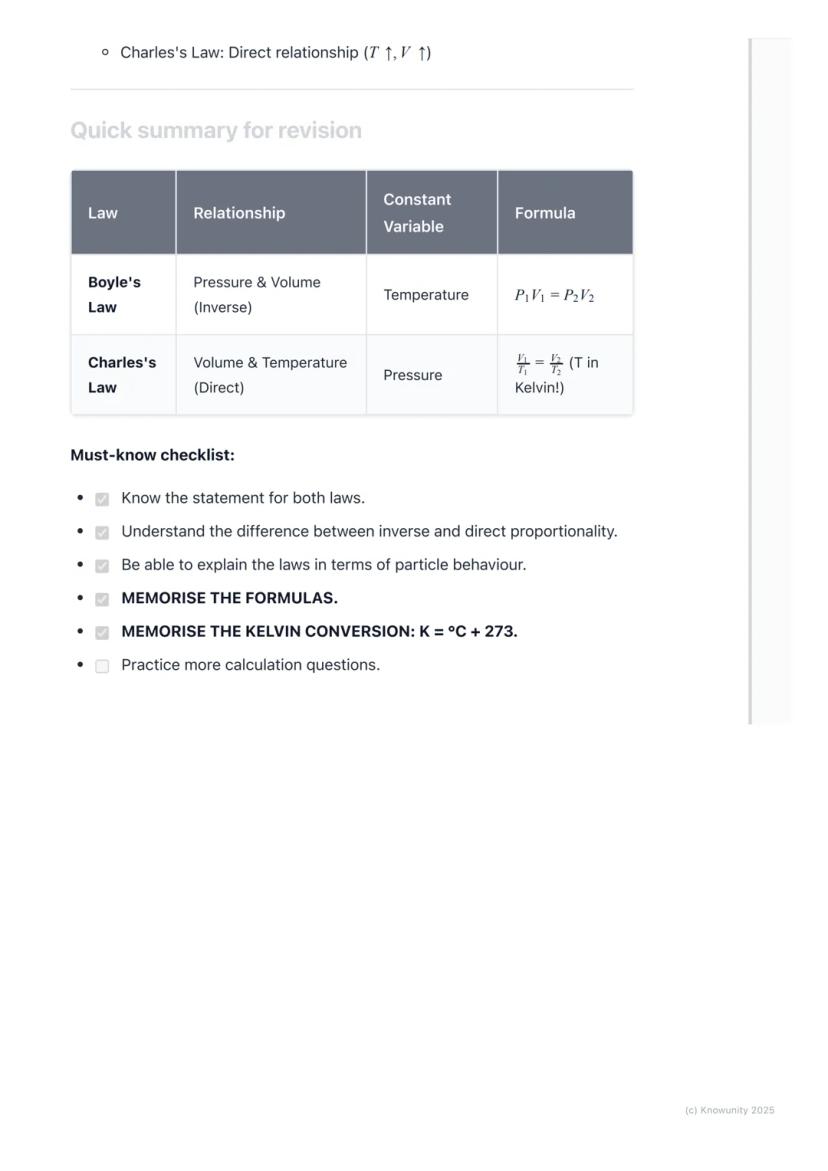
Here's your essential revision table:
| **Law** | **Relationship** | **Constant** | **Formula** |
|---|---|---|---|
| Boyle's | P & V (Inverse) | Temperature | P₁V₁ = P₂V₂ |
| Charles's | V & T (Direct) | Pressure | V₁/T₁ = V₂/T₂ |
Key exam strategies: Know both law statements perfectly. Understand that Boyle's shows inverse proportionality (one goes up, other goes down) whilst Charles's shows direct proportionality (both change in the same direction).
Practice explaining these laws using particle behaviour - it's a common exam question. Faster-moving particles need more space (Charles's), whilst squashing particles into smaller spaces increases collisions (Boyle's).
Master the formulas and that crucial Kelvin conversion. These are your bread-and-butter marks in gas law questions.
💡 Exam Success: Learn to spot which law applies by identifying which variable stays constant in the question.
7
of 7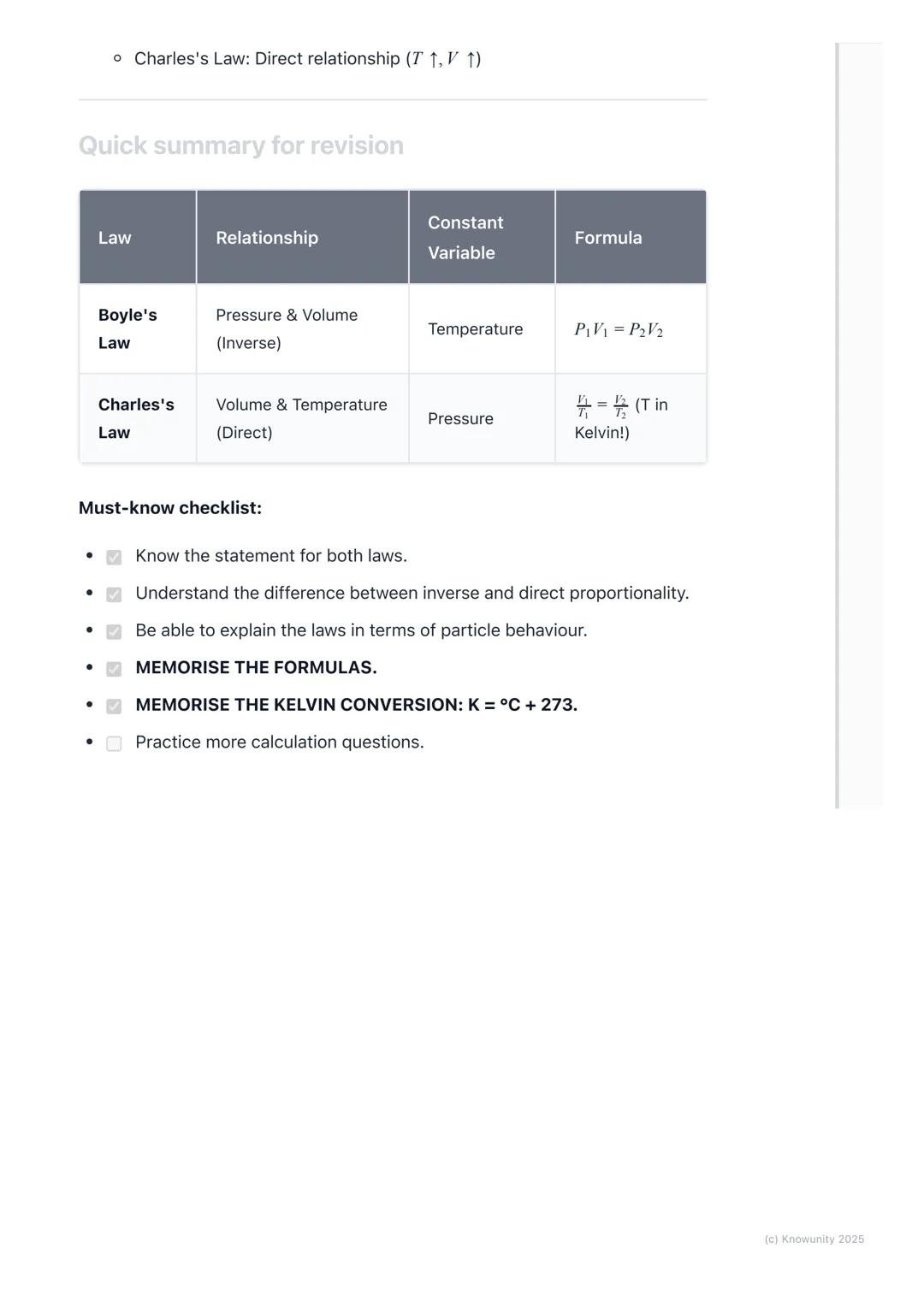
Mislili smo, da nikoli ne boš vprašal...
Kaj je Knowunity AI spremljevalec?
Naš AI Spremljevalec je orodje umetne inteligence, osredotočeno na dijake, ki ponuja več kot le odgovore. Zgrajen na milijonih virov Knowunity-ja, zagotavlja relevantne informacije, prilagojene načrte učenja, kvize in vsebino neposredno v klepetu ter se prilagaja tvoji individualni poti učenja.
Kje lahko prenesem aplikacijo Knowunity?
Aplikacijo lahko preneseš iz Google Play Store ali Apple App Store.
Je Knowunity res brezplačen?
Tako je! Uživaj v brezplačnem dostopu do učnih vsebin, se povezuj s sošolci in dobi takojšnjo pomoč – vse na dosegu roke.
Najbolj priljubljena vsebina
9Ne najdeš tistega, kar iščeš? Razišči druge predmete.
Dijaki nas obožujejo — in tudi ti boš.
4.6/5App Store
4.7/5Google Play
Aplikacija je res enostavna za uporabo in dobro oblikovana. Našel sem vse, kar sem iskal, in se iz predstavitev ogromno naučil! Aplikacijo bom zagotovo uporabil za razredno nalogo! In seveda mi je tudi super vir navdiha.
Stefan SiOS uporabnik
Ta aplikacija je res kul. Toliko zapiskov za učenje in pomoči [...]. Moj problemski predmet je na primer francoščina, in aplikacija ima toliko možnosti za pomoč. Zahvaljujoč tej aplikaciji sem izboljšal svojo francoščino. Priporočil bi jo vsem.
Samantha KlichAndroid uporabnica
Vau, res sem navdušena. Aplikacijo sem preizkusila, ker sem jo videla oglaševano večkrat, in sem bila popolnoma presenečena. Ta aplikacija je POMOČ, ki jo rabiš za šolo, in ponuja toliko stvari, kot so vaje in povzetki, ki so bili meni osebno ZELO koristni.
AnnaiOS uporabnica
Chemistry6 ogledi·Posodobljeno May 30, 2026·7 straniUnderstanding Gas Laws: Boyle's and Charles's Principles Simplified
Ever wondered why a balloon shrinks in the cold or why your ears pop when you dive deep underwater? It's all about gas laws! These simple rules explain how gases behave when pressure, volume, or temperature changes - and they're... Prikaži več
1
of 7Registriraj se za ogled vsebine. Brezplačno je!
- Dostop do vseh dokumentov
- Izboljšaj svoje ocene
- Pridruži se milijonom študentov
Understanding Gas Laws Basics
Gas laws are straightforward rules that predict how gases behave under different conditions. They're based on ideal gases - a theoretical model that works brilliantly for real gases under normal conditions.
The key thing to remember is that we're always dealing with a fixed mass of gas. This means no gas escapes or enters the container during our experiments.
You need to master some crucial definitions first. Pressure is the force gas particles exert on container walls through constant collisions. Volume is simply the space the gas occupies. Temperature measures the average kinetic energy of gas particles - faster particles mean higher temperature.
💡 Critical Point: For all gas law calculations, temperature MUST be in Kelvin. Convert by adding 273 to Celsius: K = °C + 273. This is where most students lose marks!
2
of 7Registriraj se za ogled vsebine. Brezplačno je!
- Dostop do vseh dokumentov
- Izboljšaj svoje ocene
- Pridruži se milijonom študentov
Boyle's Law - Pressure vs Volume
Boyle's Law is all about the relationship between pressure and volume whilst keeping temperature constant. Here's the key principle: volume is inversely proportional to pressure.
Double the pressure, and you'll halve the volume. It makes perfect sense when you think about particles - squeeze them into a smaller space (decrease volume), and they'll hit the walls more frequently, increasing pressure.
The mathematical relationship is beautifully simple: PV = constant. For calculations involving changes, use the formula: P₁V₁ = P₂V₂
Here's what's brilliant about this - your units just need to be consistent on both sides. If you start with cm³, your answer will be in cm³. No complicated conversions needed!
💡 Memory Trick: Boyle's Law = "Pressure squeezes" - higher pressure squeezes the volume smaller.
3
of 7Registriraj se za ogled vsebine. Brezplačno je!
- Dostop do vseh dokumentov
- Izboljšaj svoje ocene
- Pridruži se milijonom študentov
Charles's Law - Volume vs Temperature
Charles's Law explores how volume changes with temperature whilst pressure stays constant. The relationship here is directly proportional - increase temperature, increase volume by the same factor.
Picture a balloon in your car on a hot day - it expands because heated gas particles move faster and need more space. The pressure stays the same, but the volume increases to accommodate the more energetic particles.
The formula for changes is: V₁/T₁ = V₂/T₂. But here's the absolute crucial bit - temperature MUST be in Kelvin. Using Celsius will guarantee the wrong answer.
Remember: K = °C + 273. Write this conversion at the start of every Charles's Law problem. It'll save you from the most common mistake in gas law questions.
💡 Warning: Never forget Kelvin conversion! It's the number one way students mess up Charles's Law calculations.
4
of 7Registriraj se za ogled vsebine. Brezplačno je!
- Dostop do vseh dokumentov
- Izboljšaj svoje ocene
- Pridruži se milijonom študentov
Worked Example - Boyle's Law
Let's tackle a typical exam question: A gas sample has 250 cm³ volume at 100 kPa pressure. Pressure increases to 125 kPa at constant temperature. What's the new volume?
First, identify your variables: P₁ = 100 kPa, V₁ = 250 cm³, P₂ = 125 kPa, V₂ = ?
Since temperature is constant, we use Boyle's Law: P₁V₁ = P₂V₂
Substitute: (100)(250) = (125)(V₂), so 25000 = 125V₂
Solving: V₂ = 25000 ÷ 125 = 200 cm³
Always check your answer makes sense - pressure increased, so volume should decrease. 200 cm³ is less than 250 cm³, so we're spot on!
💡 Pro Tip: Always do a sense check - if pressure goes up, volume goes down in Boyle's Law.
5
of 7Registriraj se za ogled vsebine. Brezplačno je!
- Dostop do vseh dokumentov
- Izboljšaj svoje ocene
- Pridruži se milijonom študentov
Worked Example - Charles's Law
Here's a Charles's Law problem: A balloon contains 5.0 L of air at 27°C. On a cold day at 7°C, what's the new volume? (Pressure stays constant)
Step one is absolutely critical - convert to Kelvin immediately: T₁ = 27 + 273 = 300 K, T₂ = 7 + 273 = 280 K
Now identify variables: V₁ = 5.0 L, T₁ = 300 K, T₂ = 280 K, V₂ = ?
Use Charles's Law formula: V₁/T₁ = V₂/T₂
Substitute: 5.0/300 = V₂/280
Solving: V₂ = (5.0 × 280) ÷ 300 = 4.67 L
Sense check - temperature decreased, so volume should decrease. 4.67 L < 5.0 L ✓
💡 Success Strategy: Write "Convert to Kelvin!" at the top of every Charles's Law problem as a reminder.
6
of 7Registriraj se za ogled vsebine. Brezplačno je!
- Dostop do vseh dokumentov
- Izboljšaj svoje ocene
- Pridruži se milijonom študentov
Quick Reference and Exam Tips
Here's your essential revision table:
| **Law** | **Relationship** | **Constant** | **Formula** |
|---|---|---|---|
| Boyle's | P & V (Inverse) | Temperature | P₁V₁ = P₂V₂ |
| Charles's | V & T (Direct) | Pressure | V₁/T₁ = V₂/T₂ |
Key exam strategies: Know both law statements perfectly. Understand that Boyle's shows inverse proportionality (one goes up, other goes down) whilst Charles's shows direct proportionality (both change in the same direction).
Practice explaining these laws using particle behaviour - it's a common exam question. Faster-moving particles need more space (Charles's), whilst squashing particles into smaller spaces increases collisions (Boyle's).
Master the formulas and that crucial Kelvin conversion. These are your bread-and-butter marks in gas law questions.
💡 Exam Success: Learn to spot which law applies by identifying which variable stays constant in the question.
7
of 7Registriraj se za ogled vsebine. Brezplačno je!
- Dostop do vseh dokumentov
- Izboljšaj svoje ocene
- Pridruži se milijonom študentov
Mislili smo, da nikoli ne boš vprašal...
Kaj je Knowunity AI spremljevalec?
Naš AI Spremljevalec je orodje umetne inteligence, osredotočeno na dijake, ki ponuja več kot le odgovore. Zgrajen na milijonih virov Knowunity-ja, zagotavlja relevantne informacije, prilagojene načrte učenja, kvize in vsebino neposredno v klepetu ter se prilagaja tvoji individualni poti učenja.
Kje lahko prenesem aplikacijo Knowunity?
Aplikacijo lahko preneseš iz Google Play Store ali Apple App Store.
Je Knowunity res brezplačen?
Tako je! Uživaj v brezplačnem dostopu do učnih vsebin, se povezuj s sošolci in dobi takojšnjo pomoč – vse na dosegu roke.
Najbolj priljubljena vsebina
9Ne najdeš tistega, kar iščeš? Razišči druge predmete.
Dijaki nas obožujejo — in tudi ti boš.
4.6/5App Store
4.7/5Google Play
Aplikacija je res enostavna za uporabo in dobro oblikovana. Našel sem vse, kar sem iskal, in se iz predstavitev ogromno naučil! Aplikacijo bom zagotovo uporabil za razredno nalogo! In seveda mi je tudi super vir navdiha.
Stefan SiOS uporabnik
Ta aplikacija je res kul. Toliko zapiskov za učenje in pomoči [...]. Moj problemski predmet je na primer francoščina, in aplikacija ima toliko možnosti za pomoč. Zahvaljujoč tej aplikaciji sem izboljšal svojo francoščino. Priporočil bi jo vsem.
Samantha KlichAndroid uporabnica
Vau, res sem navdušena. Aplikacijo sem preizkusila, ker sem jo videla oglaševano večkrat, in sem bila popolnoma presenečena. Ta aplikacija je POMOČ, ki jo rabiš za šolo, in ponuja toliko stvari, kot so vaje in povzetki, ki so bili meni osebno ZELO koristni.
AnnaiOS uporabnica