
Ever wonder how farmers decide which animals become the parents...
 Agricultural Science1 ogledi·Posodobljeno Jun 16, 2026·6 strani
Choosing Quality Breeding Animals
1 / 6
1
of 6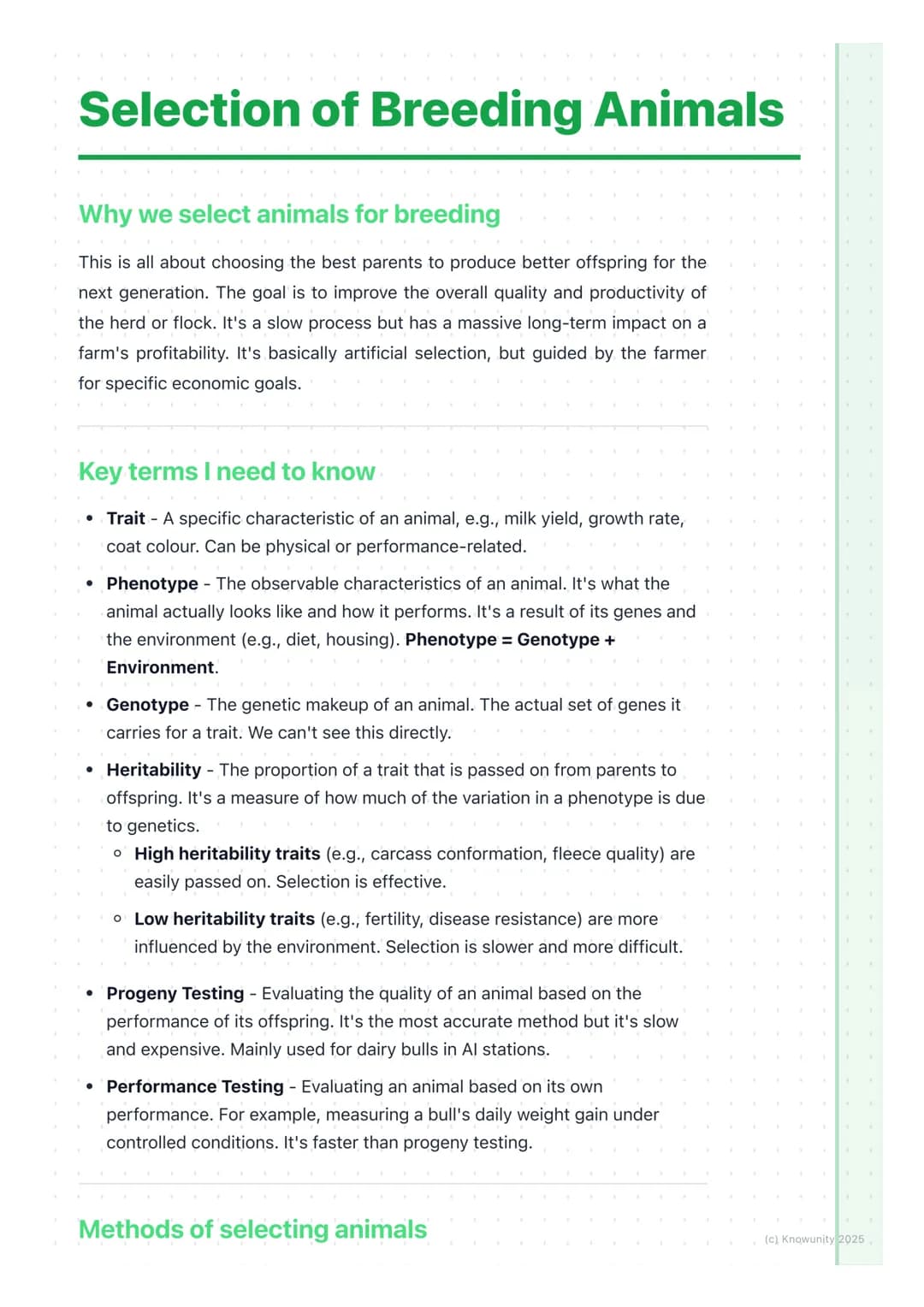
Why We Select Breeding Animals
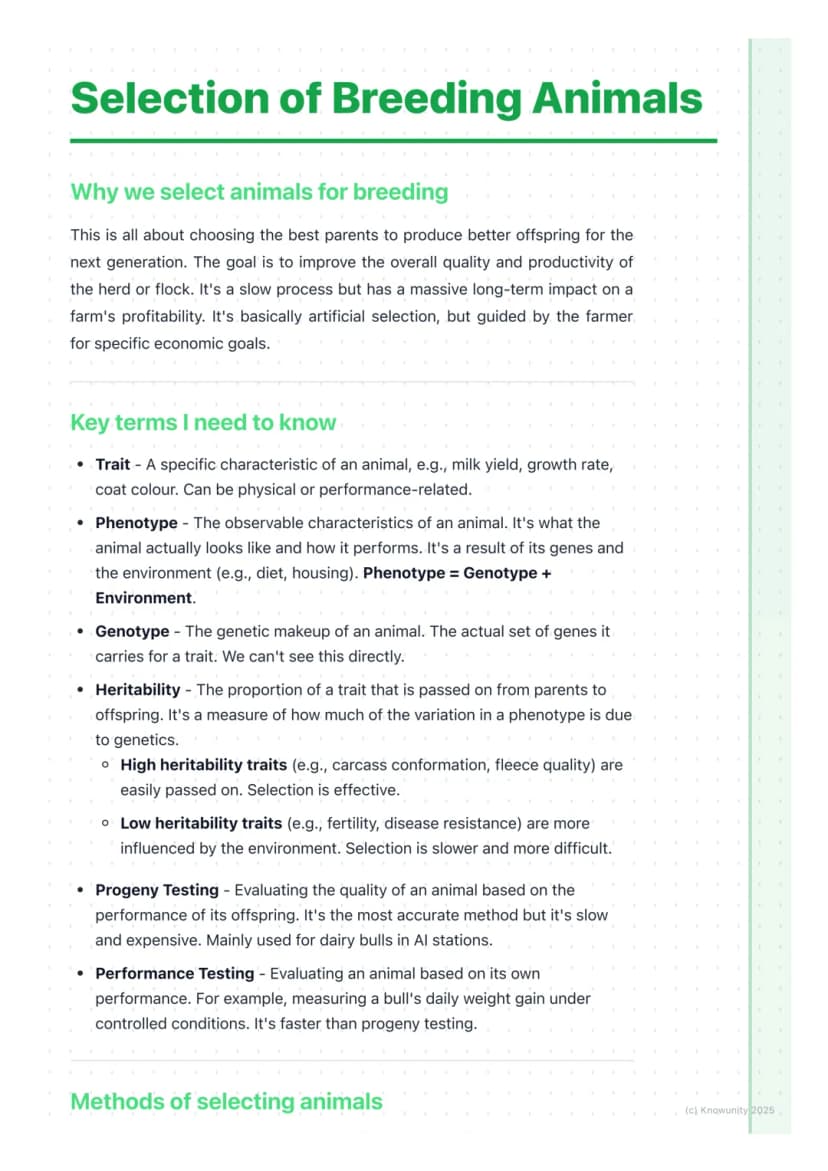
Think of animal breeding like building a championship sports team - you want the best performers to create even better offspring. Farmers use artificial selection to improve their herds over generations, focusing on economically important traits.
Understanding the key terms is essential for grasping how breeding works. A trait is any characteristic you can measure, like milk yield or growth rate. The phenotype is what you actually observe - how the animal looks and performs. The genotype is the animal's genetic blueprint that you can't see directly.
Heritability tells you how much of a trait gets passed from parents to offspring. High heritability traits like carcass quality are easily improved through selection, whilst low heritability traits like fertility require more patience and environmental management.
Key Point: Remember the formula: Phenotype = Genotype + Environment. Even animals with great genes need proper care to reach their potential.
2
of 6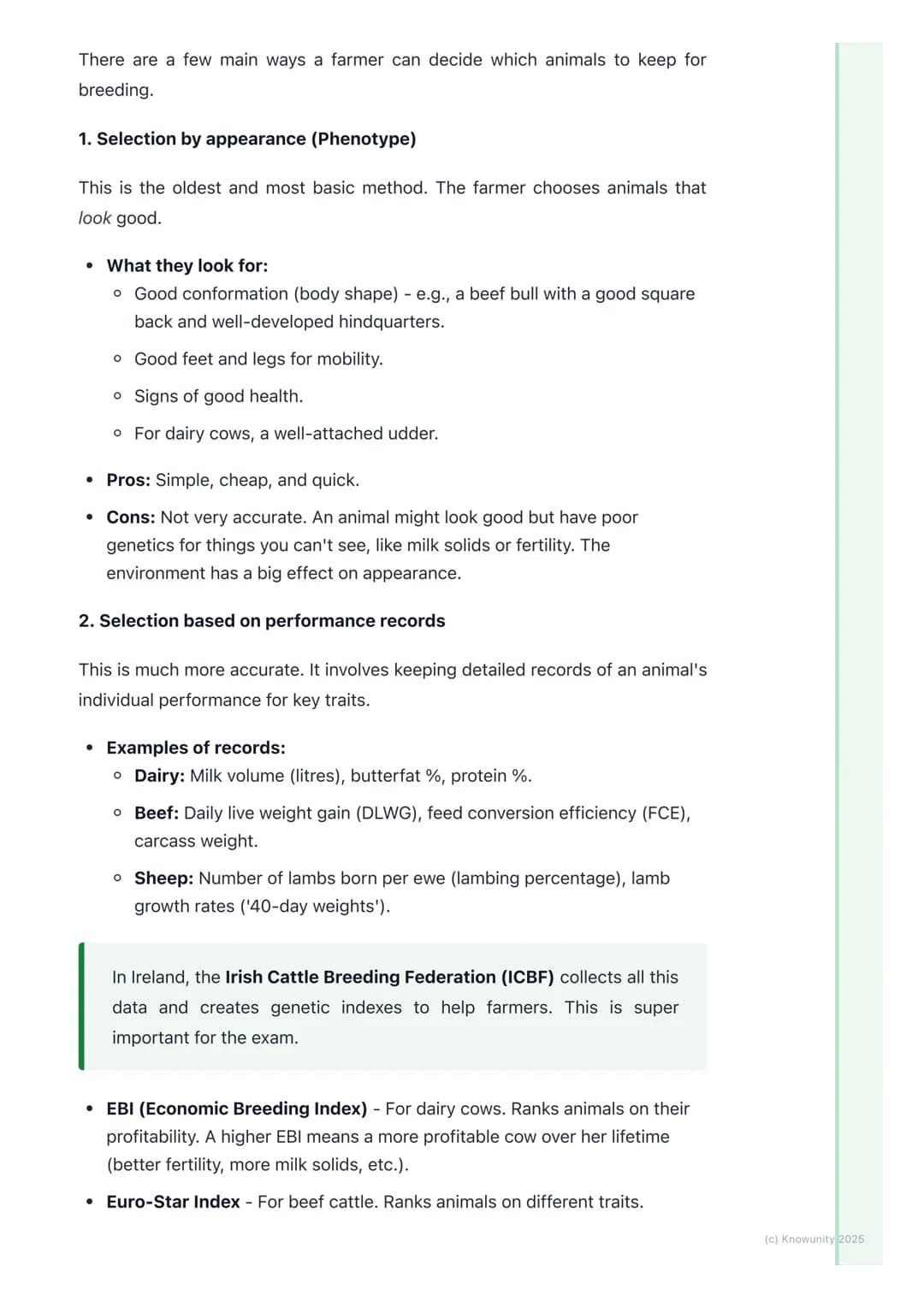
Selection Methods - From Basic to High-Tech
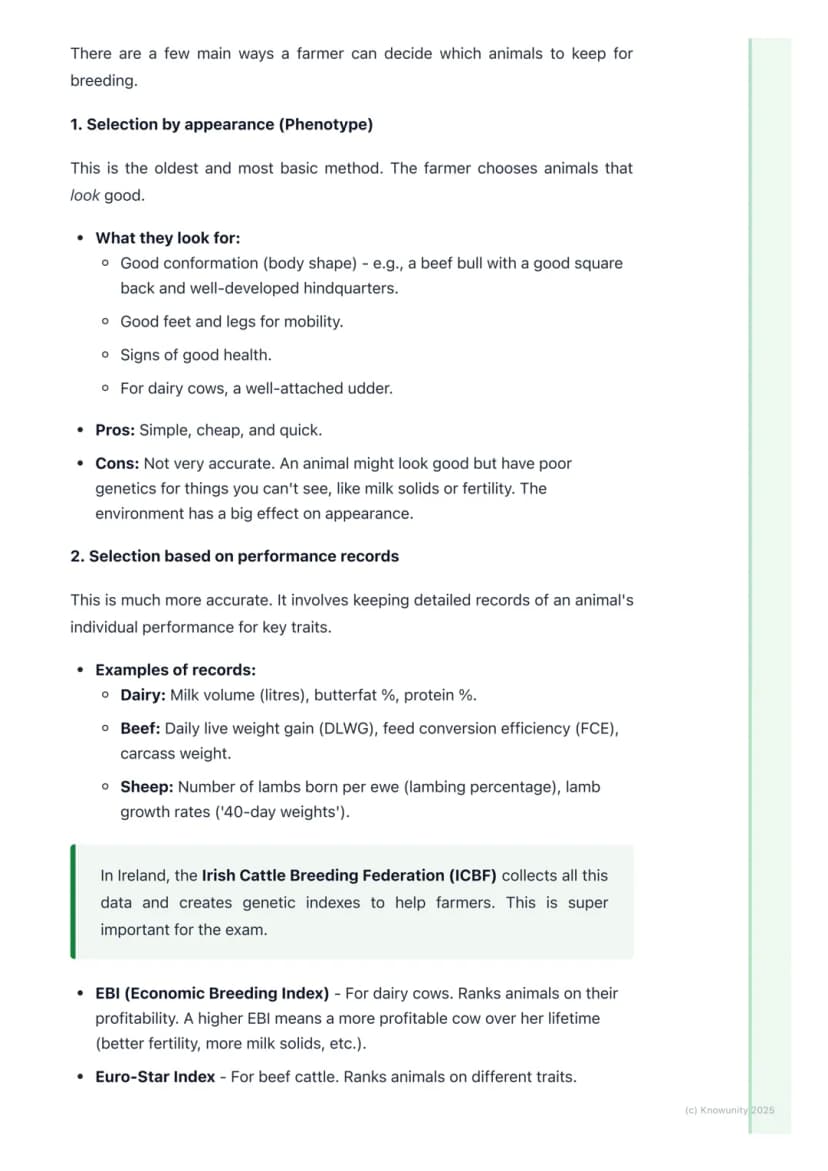
The simplest method is selection by appearance - choosing animals that look good. Farmers examine body shape, leg quality, and health signs. It's quick and cheap, but appearances can be deceiving since environment heavily influences how animals look.
Performance testing involves keeping detailed records of individual animals. Irish dairy farmers track milk volume, butterfat percentage, and protein content, whilst beef farmers measure daily weight gain and feed conversion efficiency. This data-driven approach is far more reliable than just looking at animals.
The Irish Cattle Breeding Federation (ICBF) processes all this performance data to create genetic indexes. The Economic Breeding Index (EBI) ranks dairy cows on lifetime profitability, considering milk production, fertility, and health together. For beef cattle, the Euro-Star system provides separate indexes for different purposes.
Exam Tip: Know the difference between Terminal Index (breeding for slaughter) and Replacement Index (breeding future mothers) - this comes up frequently in questions.
3
of 6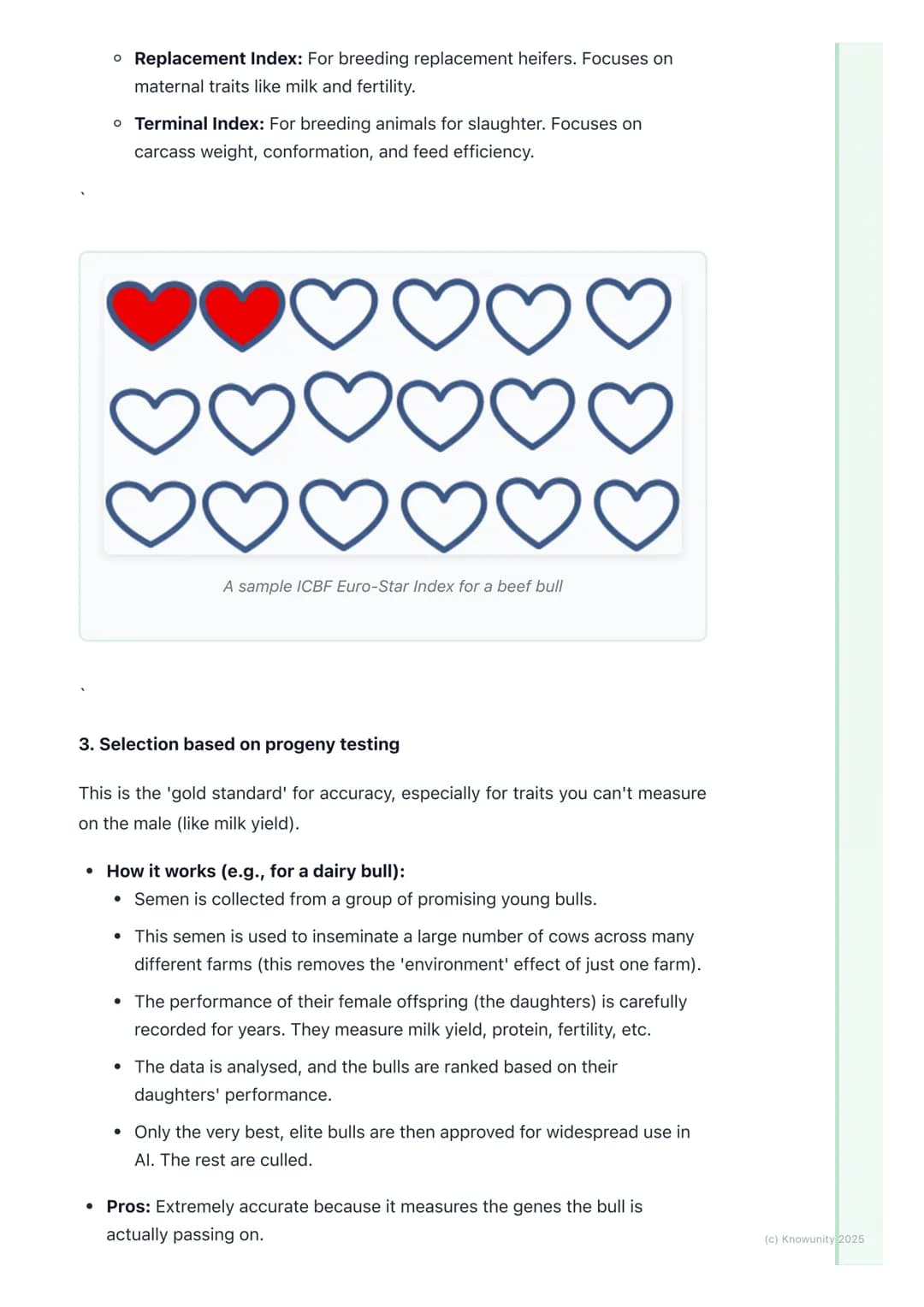
Progeny Testing - The Gold Standard
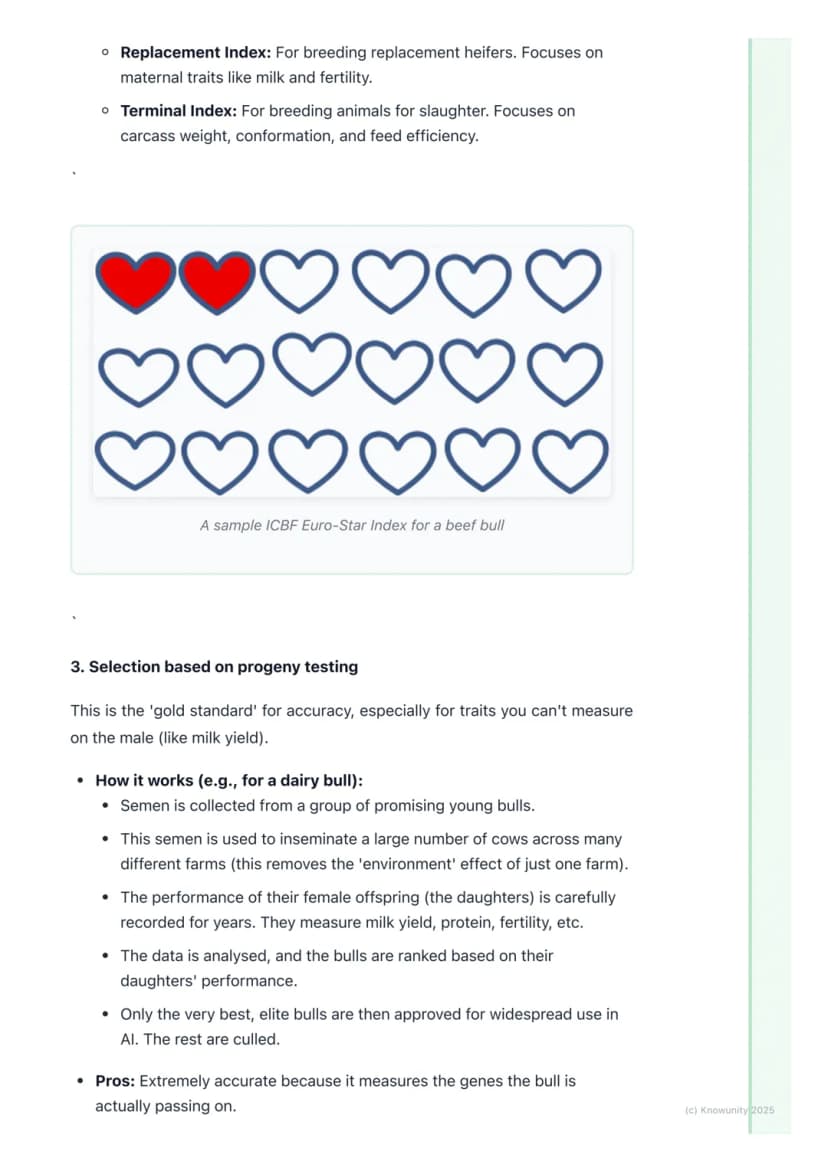
Progeny testing is like judging a teacher by how well their students perform. Young bulls have their semen collected and used across multiple farms. Years later, researchers analyse how their daughters perform compared to other cows.
This method works brilliantly for traits you can't measure directly on males, like milk production. The process takes 5-7 years and costs enormous amounts, but it's incredibly accurate because it shows what genes bulls actually pass on to offspring.
Only elite bulls that prove themselves through progeny testing get approved for widespread artificial insemination. The rest are culled, ensuring only the very best genetics spread through the population.
The system removes environmental bias by testing across different farms and management systems. If a bull's daughters consistently outperform others regardless of farm conditions, you know he's genetically superior.
Real World: This is why AI bulls are so expensive - they've undergone years of testing to prove their genetic worth.
4
of 6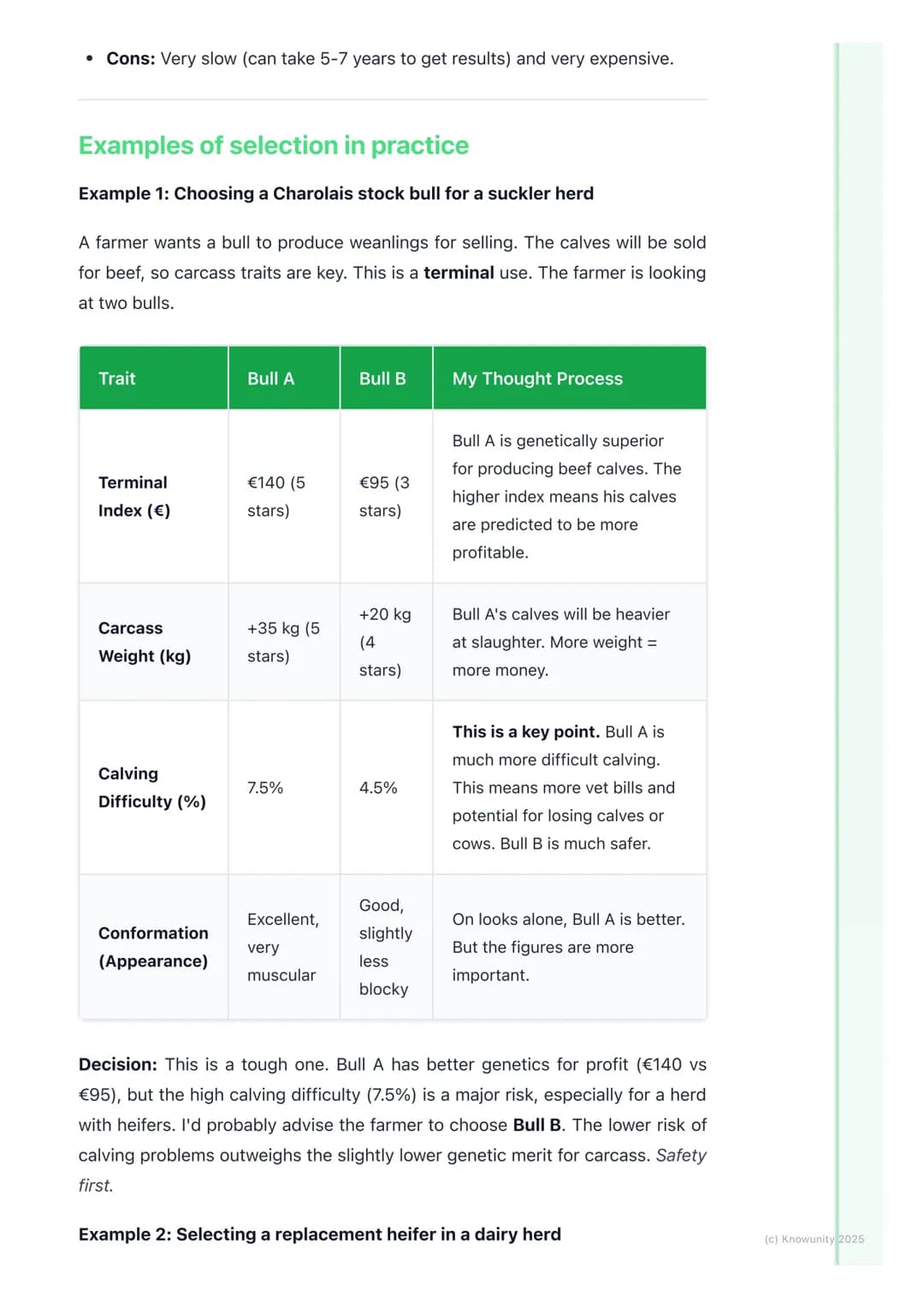
Practical Selection Examples
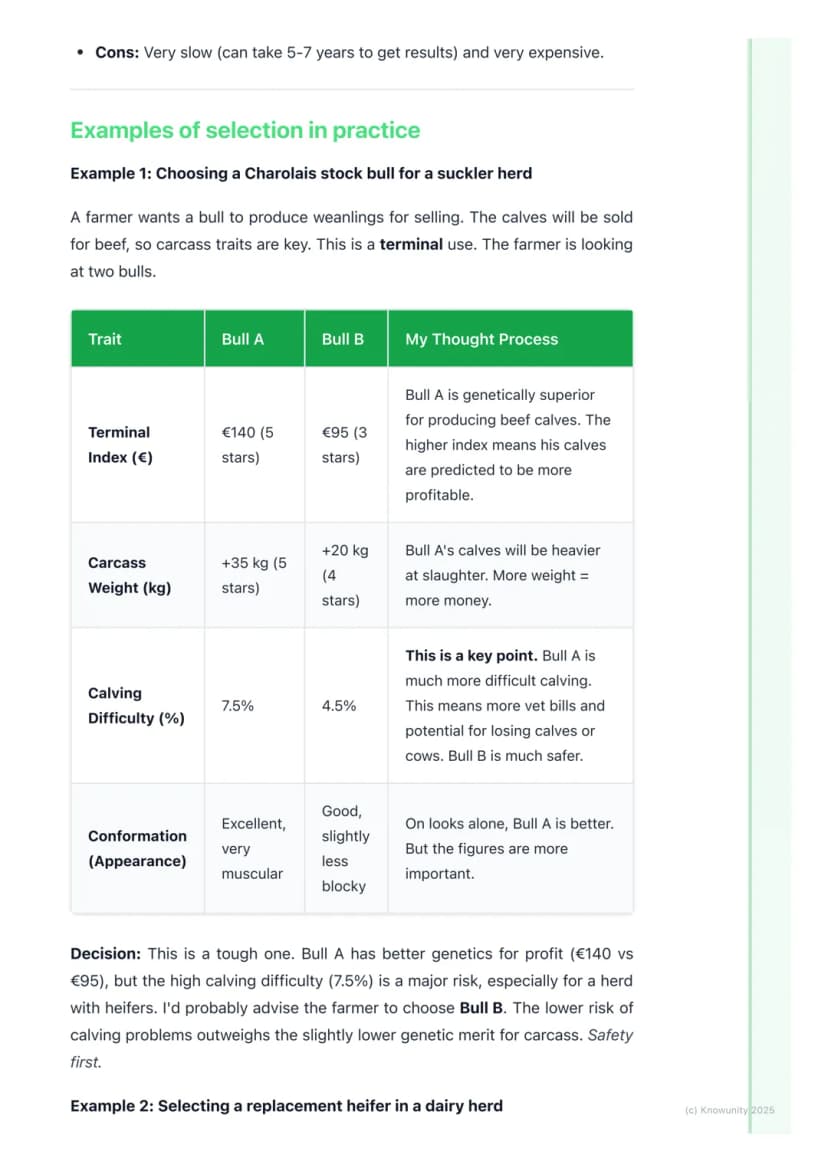
When choosing a Charolais stock bull for beef production, farmers compare terminal indexes focusing on carcass weight, conformation, and feed efficiency. Bull A might excel in daily weight gain whilst Bull B shows superior carcass quality - the choice depends on market demands and farm goals.
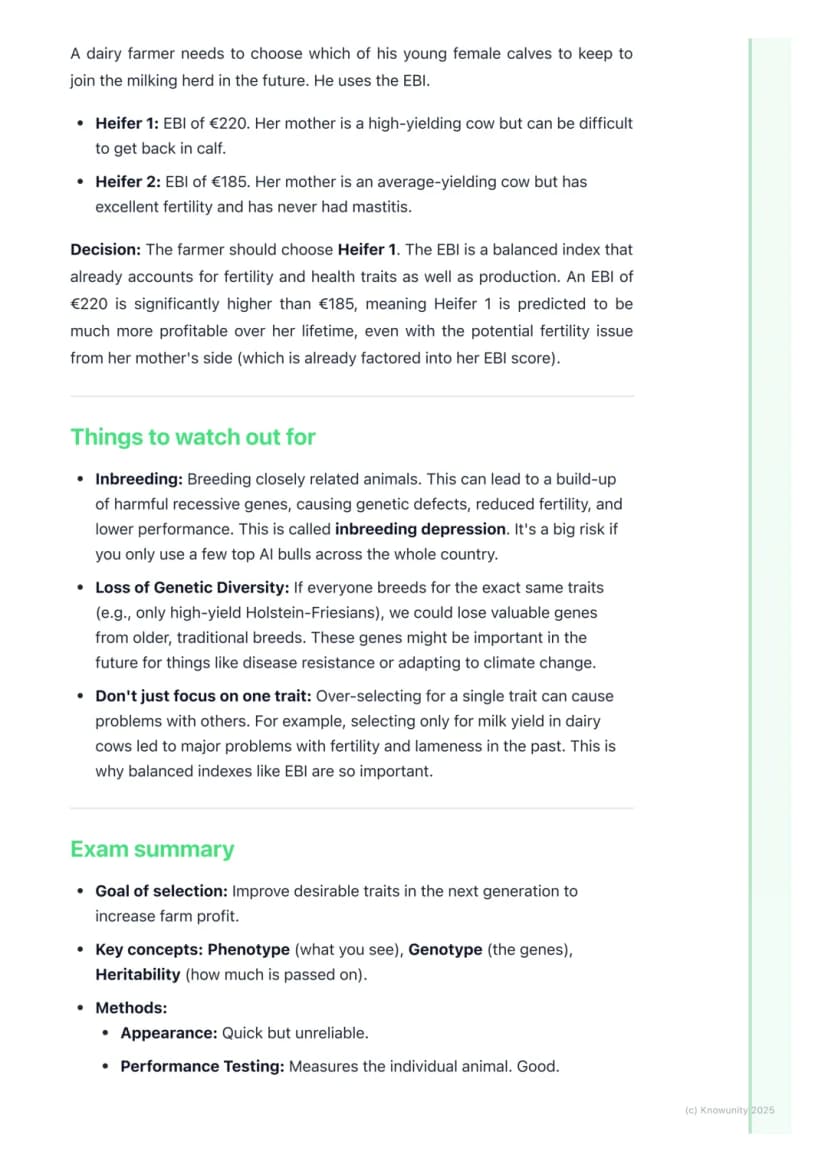
For dairy replacement heifers, farmers rely heavily on EBI scores. A heifer with an EBI of €220 will likely be more profitable over her lifetime than one scoring €185, even if her mother had fertility issues. The EBI already accounts for all major traits in balanced proportions.
Smart farmers avoid tunnel vision. Focusing solely on milk yield led to serious fertility and health problems in dairy herds during the 1980s and 1990s. This is why modern breeding uses balanced indexes that consider multiple traits simultaneously.
Selection intensity also matters - choosing only the top 10% of animals creates faster genetic progress than keeping the top 50%. However, this must be balanced against maintaining adequate herd size and genetic diversity.
Critical Thinking: Always ask yourself - what's the end goal? Terminal breeding for immediate slaughter requires different selection criteria than breeding replacement females.
5
of 6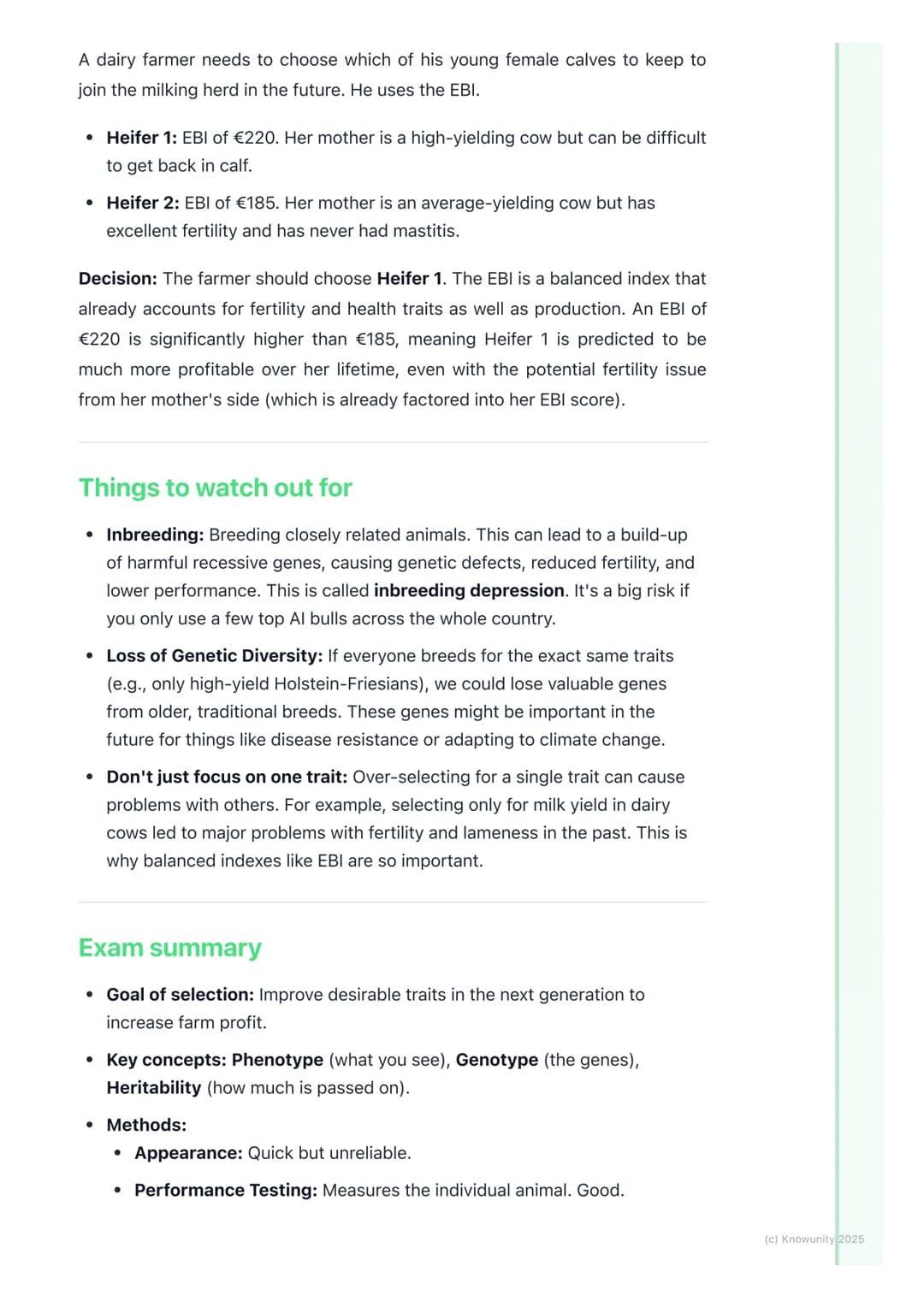
Avoiding Genetic Pitfalls
Inbreeding occurs when closely related animals mate, leading to inbreeding depression - reduced fertility, genetic defects, and poor performance. This becomes a serious risk when everyone uses the same popular AI bulls without checking family relationships.
Modern breeding programs face the challenge of maintaining genetic diversity whilst improving performance. If farmers only choose high-yielding Holstein-Friesians, valuable genes from traditional breeds might be lost forever. These genes could prove crucial for disease resistance or climate adaptation in the future.
The key is balanced selection using proven indexes rather than chasing single traits. The EBI system prevents the mistakes of the past by giving appropriate weight to fertility, health, and longevity alongside production traits.
Successful farmers understand that genetic improvement is a marathon, not a sprint. Consistent use of superior genetics combined with excellent management creates sustainable improvements over decades.
Future Focus: Climate change may require animals with different traits than today's ideal - maintaining genetic diversity keeps options open.
6
of 6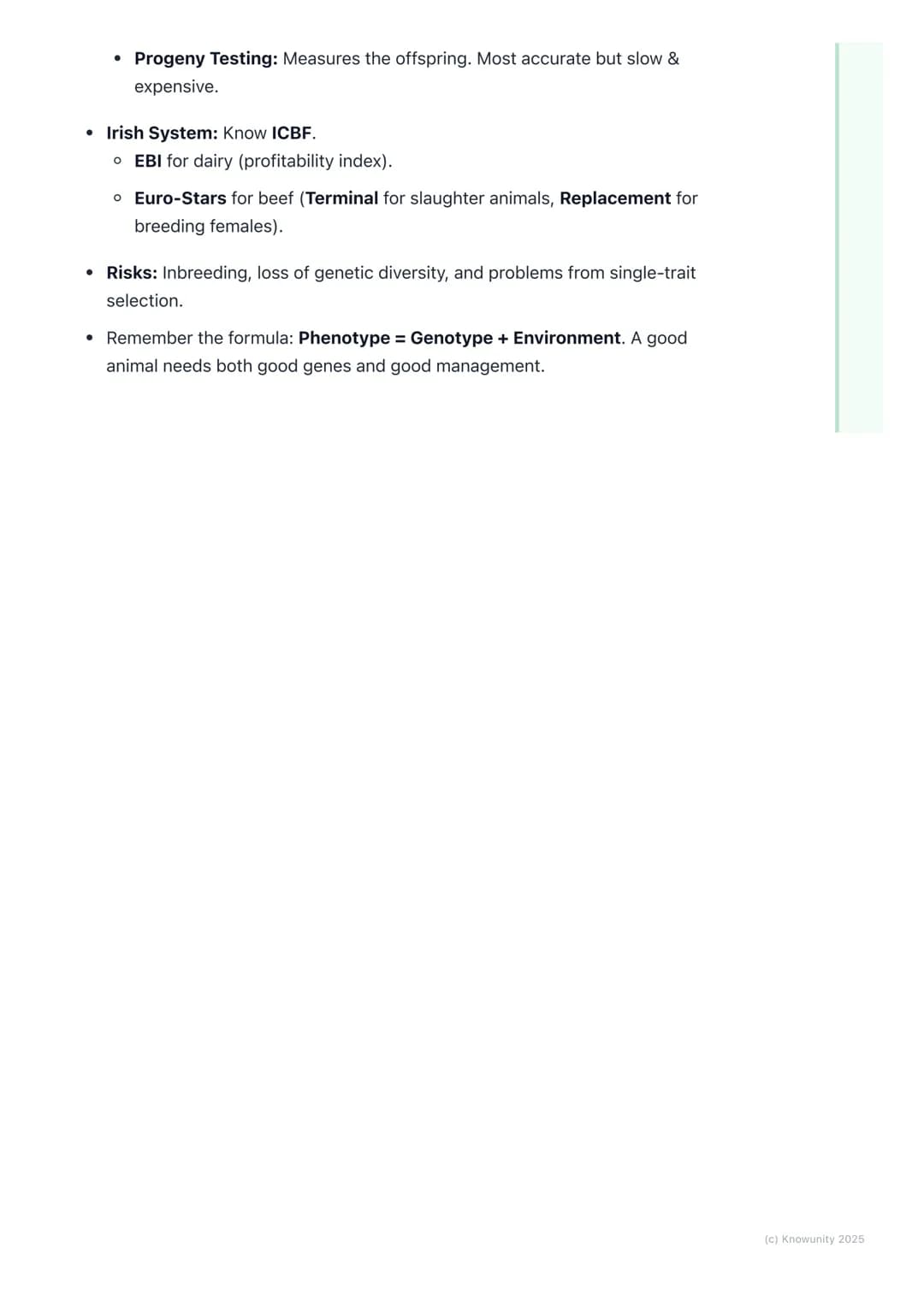
Exam Summary and Key Takeaways
Selection goals: Improve profitable traits through choosing superior parents for the next generation. Success requires understanding heritability - how much traits pass from parents to offspring.
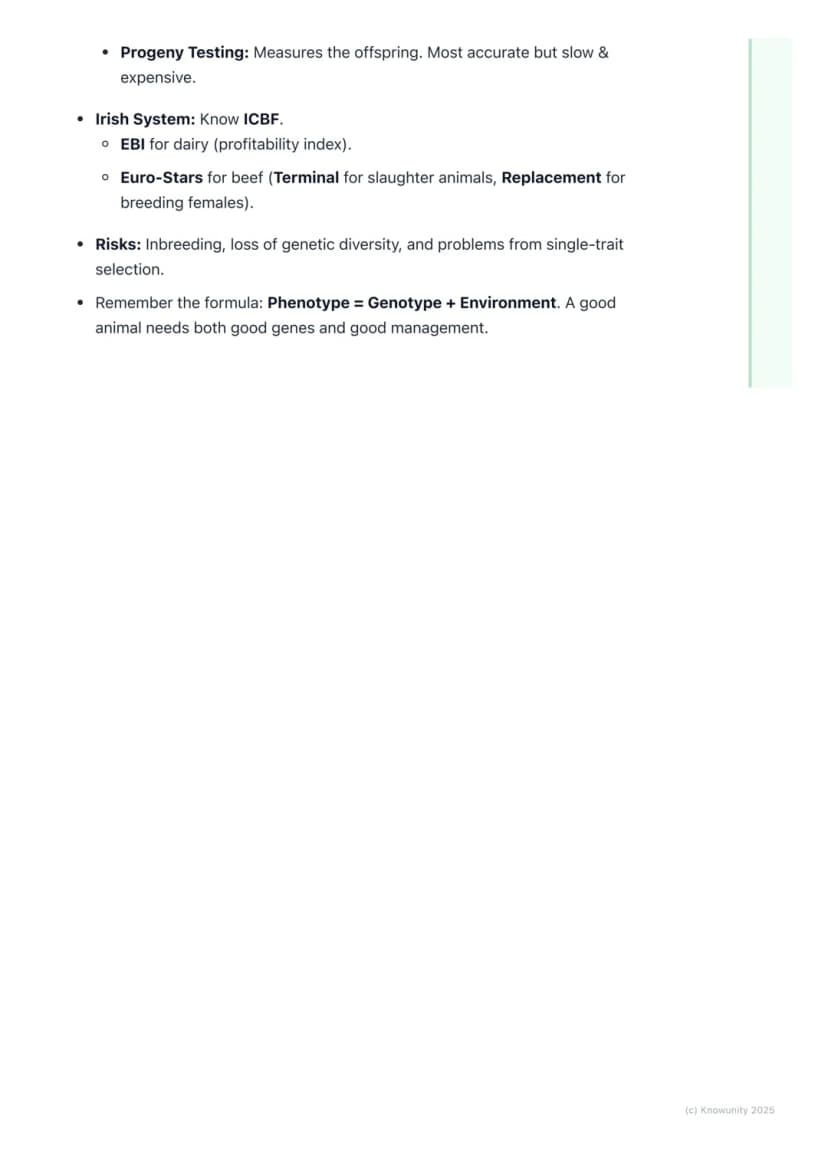
Three main methods: Appearance (quick but unreliable), performance testing (good balance of accuracy and speed), and progeny testing (most accurate but slow and expensive). Each has its place in modern breeding programs.
Irish breeding systems you must know: ICBF coordinates data collection, EBI ranks dairy cattle on lifetime profitability, and Euro-Star indexes guide beef breeding decisions. Terminal indexes focus on slaughter traits, replacement indexes on maternal abilities.
Critical risks include: inbreeding depression from using related animals, loss of genetic diversity from narrow selection, and problems from single-trait focus. Balanced selection using proven indexes avoids these pitfalls whilst maintaining steady genetic progress.
Success Formula: Great breeding = Superior genetics + Excellent management + Long-term thinking. Master this combination and you'll understand how modern agriculture creates better animals each generation.
Mislili smo, da nikoli ne boš vprašal...
Kaj je Knowunity AI spremljevalec?
Naš AI Spremljevalec je orodje umetne inteligence, osredotočeno na dijake, ki ponuja več kot le odgovore. Zgrajen na milijonih virov Knowunity-ja, zagotavlja relevantne informacije, prilagojene načrte učenja, kvize in vsebino neposredno v klepetu ter se prilagaja tvoji individualni poti učenja.
Kje lahko prenesem aplikacijo Knowunity?
Aplikacijo lahko preneseš iz Google Play Store ali Apple App Store.
Je Knowunity res brezplačen?
Tako je! Uživaj v brezplačnem dostopu do učnih vsebin, se povezuj s sošolci in dobi takojšnjo pomoč – vse na dosegu roke.
Najbolj priljubljena vsebina
9 Irish
IrishIrish oral questions and answers
Questions and answers for the leaving cert oral
5th Year4264
 English
Key Quotes : Sive
Key Quotes and explanations: Sive
6th Year2842
IrishIrish oral questions
Outline of oral questions
5th Year2055
IrishIníon- le hÁine Durkin
Aine Durkin’s poem, Iníon: Themes & summary
5th Year850
IrishIrish poetry 2027
Iníon + Dínit an Bhróin
5th Year1133
IrishLC HL notes- Iníon (poem)
Includes poem in English and Irish, theme, key words & phrases
5th Year2284
EnglishCultural Context : Shawshank Redemption : Sive : Small Things Like These
Comparative Study : Cultural Context : Shawshank Redemption, Sive and Small Things Like These
6th Year1430
IrishMo Ghrá-sa (Idir Lúibíní)
Notes on mo ghrá-sa
5th Year380
IrishAn Gaeilge Aiste
Irish Language essay
6th Year1320
Ne najdeš tistega, kar iščeš? Razišči druge predmete.
Dijaki nas obožujejo — in tudi ti boš.
4.6/5App Store
4.7/5Google Play
Aplikacija je res enostavna za uporabo in dobro oblikovana. Našel sem vse, kar sem iskal, in se iz predstavitev ogromno naučil! Aplikacijo bom zagotovo uporabil za razredno nalogo! In seveda mi je tudi super vir navdiha.
Stefan SiOS uporabnik
Ta aplikacija je res kul. Toliko zapiskov za učenje in pomoči [...]. Moj problemski predmet je na primer francoščina, in aplikacija ima toliko možnosti za pomoč. Zahvaljujoč tej aplikaciji sem izboljšal svojo francoščino. Priporočil bi jo vsem.
Samantha KlichAndroid uporabnica
Vau, res sem navdušena. Aplikacijo sem preizkusila, ker sem jo videla oglaševano večkrat, in sem bila popolnoma presenečena. Ta aplikacija je POMOČ, ki jo rabiš za šolo, in ponuja toliko stvari, kot so vaje in povzetki, ki so bili meni osebno ZELO koristni.
AnnaiOS uporabnica
Agricultural Science1 ogledi·Posodobljeno Jun 16, 2026·6 straniChoosing Quality Breeding Animals
Ever wonder how farmers decide which animals become the parents of the next generation? It's all about artificial selection- choosing the best breeding animals to improve traits like milk production, growth rate, and disease resistance. This process is crucial...
1
of 6
Registriraj se za ogled vsebine. Brezplačno je!
- Dostop do vseh dokumentov
- Izboljšaj svoje ocene
- Pridruži se milijonom študentov
Why We Select Breeding Animals
Think of animal breeding like building a championship sports team - you want the best performers to create even better offspring. Farmers use artificial selection to improve their herds over generations, focusing on economically important traits.
Understanding the key terms is essential for grasping how breeding works. A trait is any characteristic you can measure, like milk yield or growth rate. The phenotype is what you actually observe - how the animal looks and performs. The genotype is the animal's genetic blueprint that you can't see directly.
Heritability tells you how much of a trait gets passed from parents to offspring. High heritability traits like carcass quality are easily improved through selection, whilst low heritability traits like fertility require more patience and environmental management.
Key Point: Remember the formula: Phenotype = Genotype + Environment. Even animals with great genes need proper care to reach their potential.
2
of 6Registriraj se za ogled vsebine. Brezplačno je!
- Dostop do vseh dokumentov
- Izboljšaj svoje ocene
- Pridruži se milijonom študentov
Selection Methods - From Basic to High-Tech
The simplest method is selection by appearance - choosing animals that look good. Farmers examine body shape, leg quality, and health signs. It's quick and cheap, but appearances can be deceiving since environment heavily influences how animals look.
Performance testing involves keeping detailed records of individual animals. Irish dairy farmers track milk volume, butterfat percentage, and protein content, whilst beef farmers measure daily weight gain and feed conversion efficiency. This data-driven approach is far more reliable than just looking at animals.
The Irish Cattle Breeding Federation (ICBF) processes all this performance data to create genetic indexes. The Economic Breeding Index (EBI) ranks dairy cows on lifetime profitability, considering milk production, fertility, and health together. For beef cattle, the Euro-Star system provides separate indexes for different purposes.
Exam Tip: Know the difference between Terminal Index (breeding for slaughter) and Replacement Index (breeding future mothers) - this comes up frequently in questions.
3
of 6Registriraj se za ogled vsebine. Brezplačno je!
- Dostop do vseh dokumentov
- Izboljšaj svoje ocene
- Pridruži se milijonom študentov
Progeny Testing - The Gold Standard
Progeny testing is like judging a teacher by how well their students perform. Young bulls have their semen collected and used across multiple farms. Years later, researchers analyse how their daughters perform compared to other cows.
This method works brilliantly for traits you can't measure directly on males, like milk production. The process takes 5-7 years and costs enormous amounts, but it's incredibly accurate because it shows what genes bulls actually pass on to offspring.
Only elite bulls that prove themselves through progeny testing get approved for widespread artificial insemination. The rest are culled, ensuring only the very best genetics spread through the population.
The system removes environmental bias by testing across different farms and management systems. If a bull's daughters consistently outperform others regardless of farm conditions, you know he's genetically superior.
Real World: This is why AI bulls are so expensive - they've undergone years of testing to prove their genetic worth.
4
of 6Registriraj se za ogled vsebine. Brezplačno je!
- Dostop do vseh dokumentov
- Izboljšaj svoje ocene
- Pridruži se milijonom študentov
Practical Selection Examples
When choosing a Charolais stock bull for beef production, farmers compare terminal indexes focusing on carcass weight, conformation, and feed efficiency. Bull A might excel in daily weight gain whilst Bull B shows superior carcass quality - the choice depends on market demands and farm goals.
For dairy replacement heifers, farmers rely heavily on EBI scores. A heifer with an EBI of €220 will likely be more profitable over her lifetime than one scoring €185, even if her mother had fertility issues. The EBI already accounts for all major traits in balanced proportions.
Smart farmers avoid tunnel vision. Focusing solely on milk yield led to serious fertility and health problems in dairy herds during the 1980s and 1990s. This is why modern breeding uses balanced indexes that consider multiple traits simultaneously.
Selection intensity also matters - choosing only the top 10% of animals creates faster genetic progress than keeping the top 50%. However, this must be balanced against maintaining adequate herd size and genetic diversity.
Critical Thinking: Always ask yourself - what's the end goal? Terminal breeding for immediate slaughter requires different selection criteria than breeding replacement females.
5
of 6Registriraj se za ogled vsebine. Brezplačno je!
- Dostop do vseh dokumentov
- Izboljšaj svoje ocene
- Pridruži se milijonom študentov
Avoiding Genetic Pitfalls
Inbreeding occurs when closely related animals mate, leading to inbreeding depression - reduced fertility, genetic defects, and poor performance. This becomes a serious risk when everyone uses the same popular AI bulls without checking family relationships.
Modern breeding programs face the challenge of maintaining genetic diversity whilst improving performance. If farmers only choose high-yielding Holstein-Friesians, valuable genes from traditional breeds might be lost forever. These genes could prove crucial for disease resistance or climate adaptation in the future.
The key is balanced selection using proven indexes rather than chasing single traits. The EBI system prevents the mistakes of the past by giving appropriate weight to fertility, health, and longevity alongside production traits.
Successful farmers understand that genetic improvement is a marathon, not a sprint. Consistent use of superior genetics combined with excellent management creates sustainable improvements over decades.
Future Focus: Climate change may require animals with different traits than today's ideal - maintaining genetic diversity keeps options open.
6
of 6Registriraj se za ogled vsebine. Brezplačno je!
- Dostop do vseh dokumentov
- Izboljšaj svoje ocene
- Pridruži se milijonom študentov
Exam Summary and Key Takeaways
Selection goals: Improve profitable traits through choosing superior parents for the next generation. Success requires understanding heritability - how much traits pass from parents to offspring.
Three main methods: Appearance (quick but unreliable), performance testing (good balance of accuracy and speed), and progeny testing (most accurate but slow and expensive). Each has its place in modern breeding programs.
Irish breeding systems you must know: ICBF coordinates data collection, EBI ranks dairy cattle on lifetime profitability, and Euro-Star indexes guide beef breeding decisions. Terminal indexes focus on slaughter traits, replacement indexes on maternal abilities.
Critical risks include: inbreeding depression from using related animals, loss of genetic diversity from narrow selection, and problems from single-trait focus. Balanced selection using proven indexes avoids these pitfalls whilst maintaining steady genetic progress.
Success Formula: Great breeding = Superior genetics + Excellent management + Long-term thinking. Master this combination and you'll understand how modern agriculture creates better animals each generation.
Mislili smo, da nikoli ne boš vprašal...
Kaj je Knowunity AI spremljevalec?
Naš AI Spremljevalec je orodje umetne inteligence, osredotočeno na dijake, ki ponuja več kot le odgovore. Zgrajen na milijonih virov Knowunity-ja, zagotavlja relevantne informacije, prilagojene načrte učenja, kvize in vsebino neposredno v klepetu ter se prilagaja tvoji individualni poti učenja.
Kje lahko prenesem aplikacijo Knowunity?
Aplikacijo lahko preneseš iz Google Play Store ali Apple App Store.
Je Knowunity res brezplačen?
Tako je! Uživaj v brezplačnem dostopu do učnih vsebin, se povezuj s sošolci in dobi takojšnjo pomoč – vse na dosegu roke.
Najbolj priljubljena vsebina
9IrishIrish oral questions and answers
Questions and answers for the leaving cert oral
5th Year4264
EnglishKey Quotes : Sive
Key Quotes and explanations: Sive
6th Year2842
IrishIrish oral questions
Outline of oral questions
5th Year2055
IrishIníon- le hÁine Durkin
Aine Durkin’s poem, Iníon: Themes & summary
5th Year850
IrishIrish poetry 2027
Iníon + Dínit an Bhróin
5th Year1133
IrishLC HL notes- Iníon (poem)
Includes poem in English and Irish, theme, key words & phrases
5th Year2284
EnglishCultural Context : Shawshank Redemption : Sive : Small Things Like These
Comparative Study : Cultural Context : Shawshank Redemption, Sive and Small Things Like These
6th Year1430
IrishMo Ghrá-sa (Idir Lúibíní)
Notes on mo ghrá-sa
5th Year380
IrishAn Gaeilge Aiste
Irish Language essay
6th Year1320
Ne najdeš tistega, kar iščeš? Razišči druge predmete.
Dijaki nas obožujejo — in tudi ti boš.
4.6/5App Store
4.7/5Google Play
Aplikacija je res enostavna za uporabo in dobro oblikovana. Našel sem vse, kar sem iskal, in se iz predstavitev ogromno naučil! Aplikacijo bom zagotovo uporabil za razredno nalogo! In seveda mi je tudi super vir navdiha.
Stefan SiOS uporabnik
Ta aplikacija je res kul. Toliko zapiskov za učenje in pomoči [...]. Moj problemski predmet je na primer francoščina, in aplikacija ima toliko možnosti za pomoč. Zahvaljujoč tej aplikaciji sem izboljšal svojo francoščino. Priporočil bi jo vsem.
Samantha KlichAndroid uporabnica
Vau, res sem navdušena. Aplikacijo sem preizkusila, ker sem jo videla oglaševano večkrat, in sem bila popolnoma presenečena. Ta aplikacija je POMOČ, ki jo rabiš za šolo, in ponuja toliko stvari, kot so vaje in povzetki, ki so bili meni osebno ZELO koristni.
AnnaiOS uporabnica