
The two-column cash book is your go-to tool for tracking...
 Accounting2 ogledi·Posodobljeno Jun 12, 2026·6 strani
The Two-Column Cash Book Explained
1 / 6
1
of 6
What is a Two-Column Cash Book?
Ever wondered how businesses keep track of all their money? The cash book is like the financial control centre of any business. It's where you first record transactions, making it a book of original entry, but it's also clever enough to be part of the main accounting system (the ledger).
This special book handles both your physical cash and your bank account transactions all in one place. Instead of having separate books for cash and bank money, you get everything organised together - pretty handy, right?
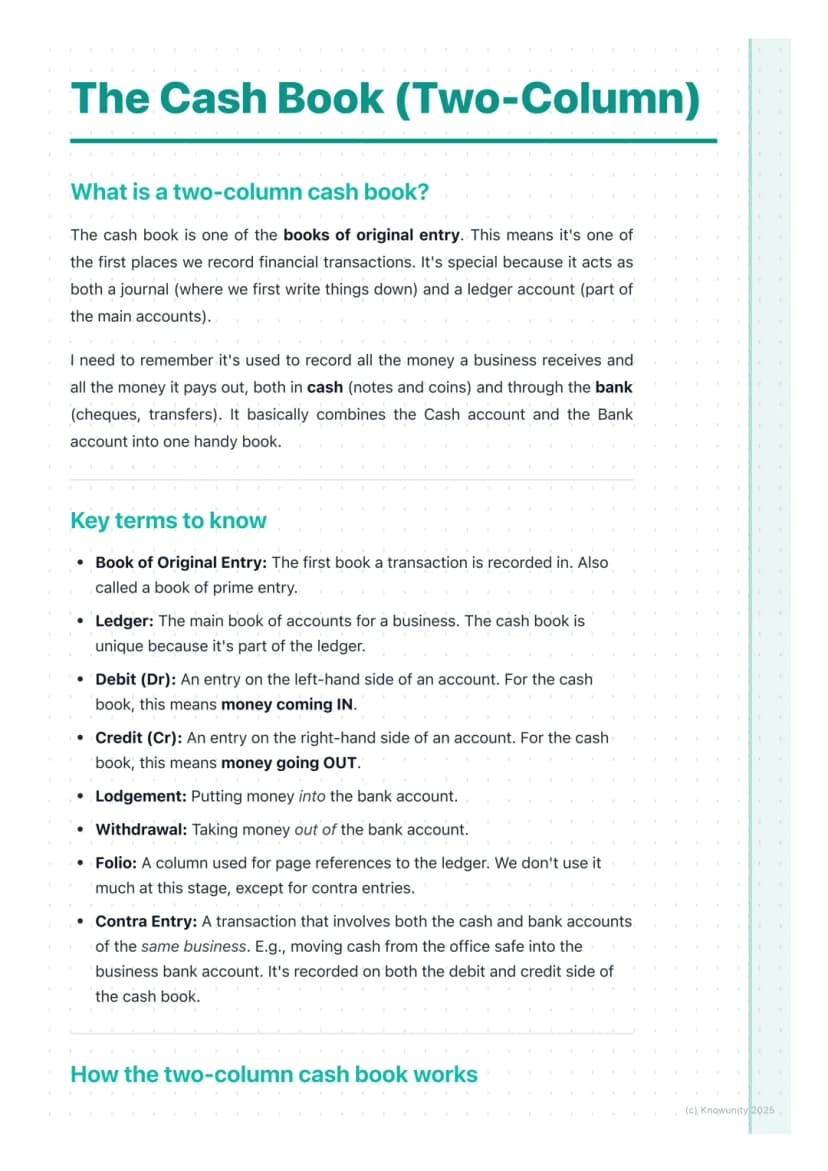
The key thing to remember is simple: debit means money coming IN (left side), and credit means money going OUT (right side). Once you've got this basic rule down, you're halfway there!
Quick Tip: Think of 'debit' as 'deposit' - both start with 'D' and mean money coming in!
2
of 6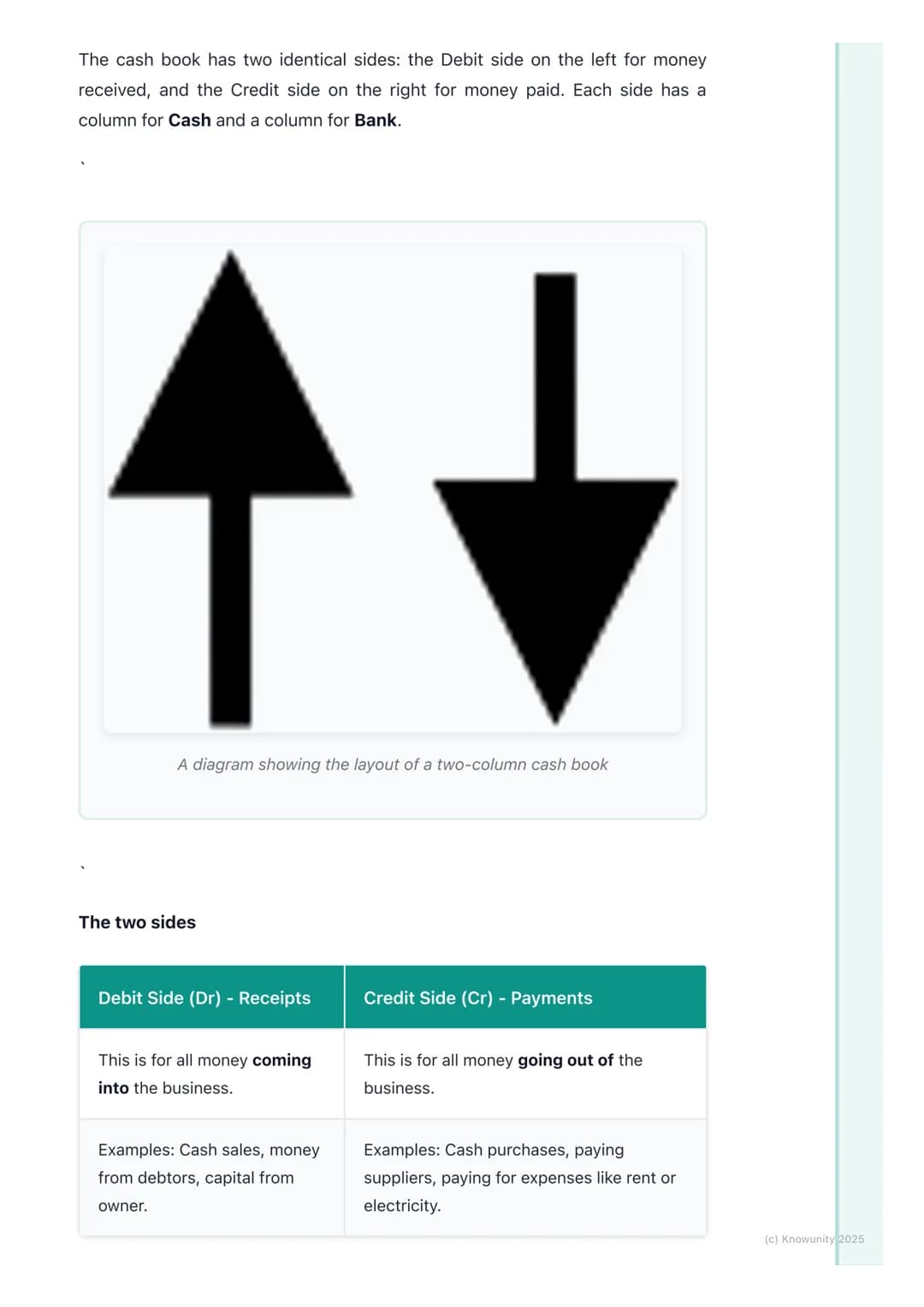
How the Two-Column Cash Book Works
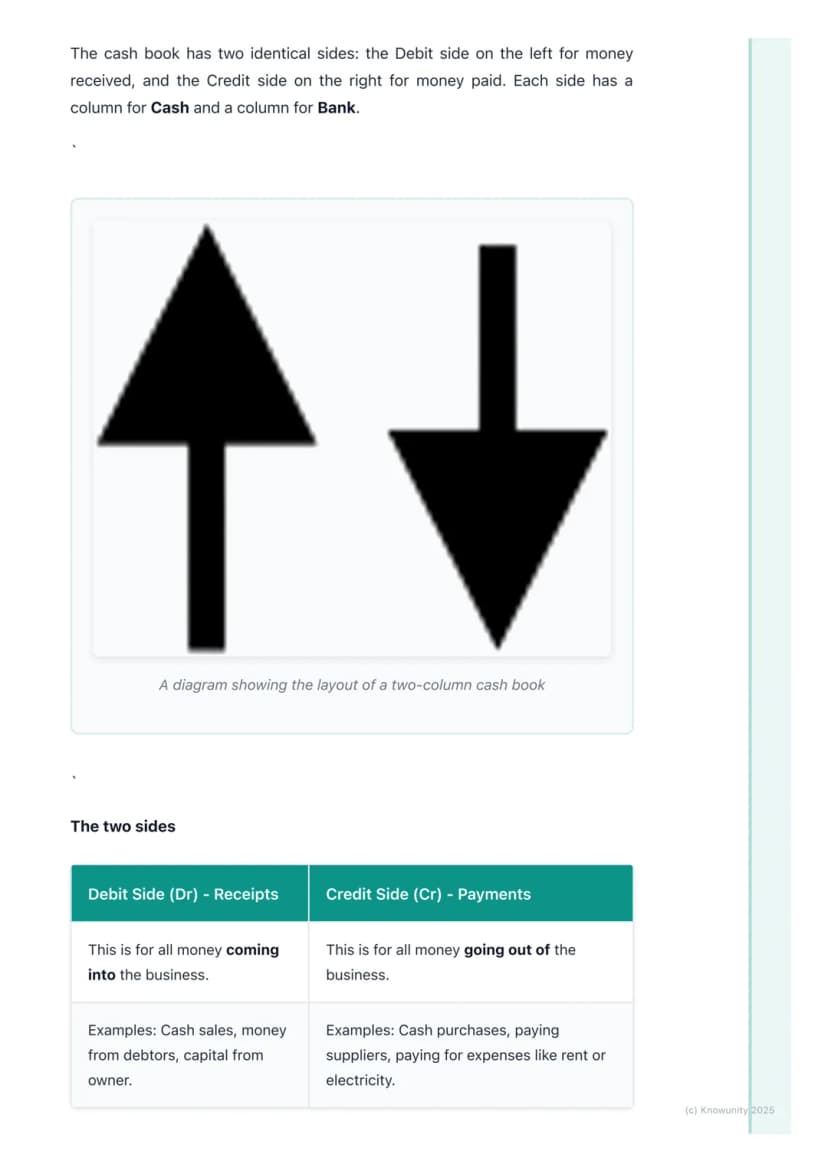
Picture your cash book like a split screen - identical left and right sides, each with columns for Cash and Bank. The left side (debit) captures all money flowing into the business, whilst the right side (credit) tracks every payment going out.
On the debit side, you'll record things like cash sales, money from customers who owed you, or capital invested by the owner. It's basically your 'income diary' for both cash and bank receipts.
The credit side handles all your outgoings - cash purchases, paying suppliers, rent, electricity bills, and any other business expenses. Whether you pay with physical cash or write a cheque, it all gets recorded here.
The beauty of this system is its simplicity: ask yourself 'Is money coming in or going out?' Then pick the correct side and the right column (cash or bank).
Remember: You can't have negative physical cash, so the cash column will never show a credit balance!
3
of 6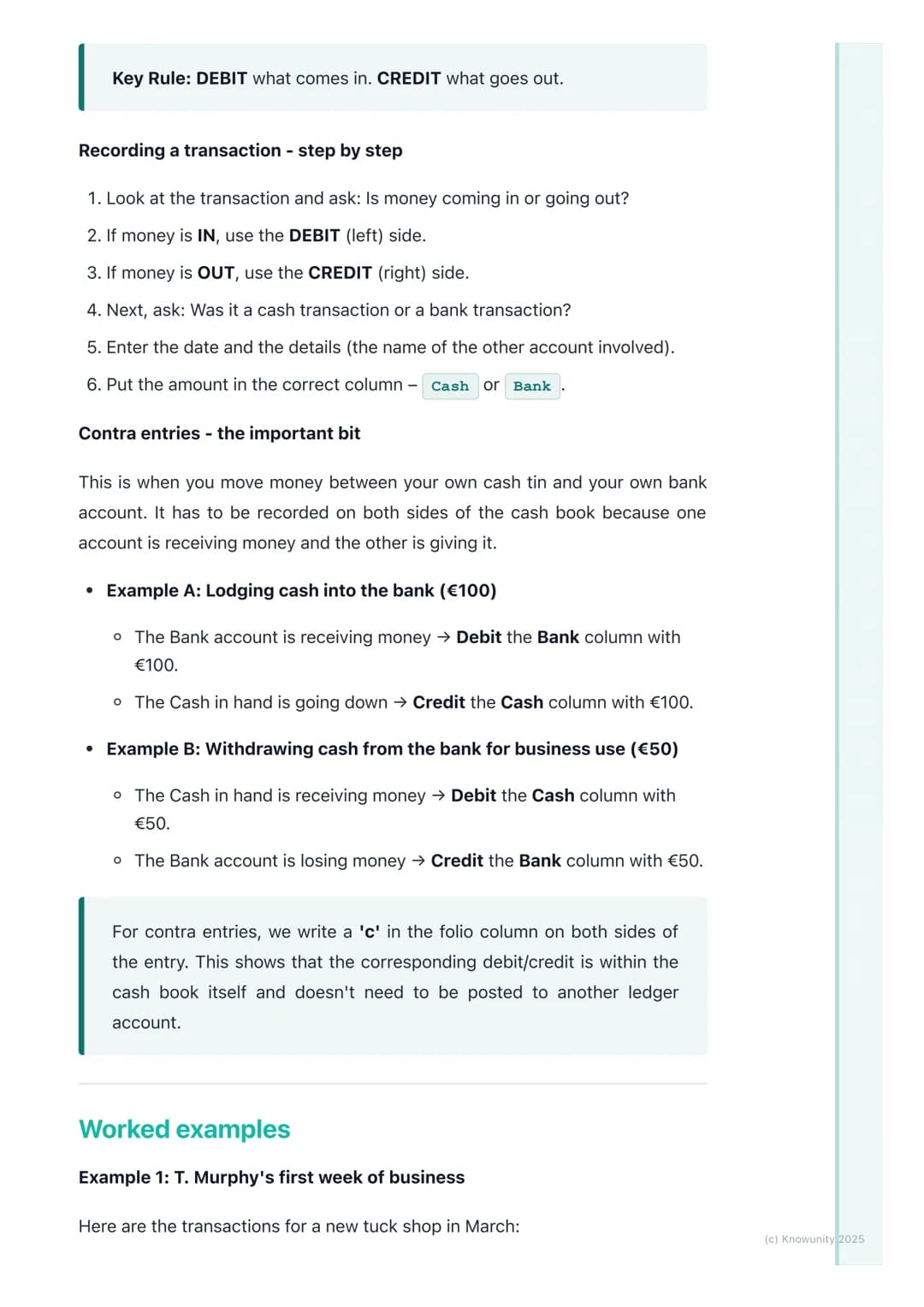
Recording Transactions Step by Step
Recording transactions becomes dead easy once you follow this simple process. First, identify whether money is flowing in or out of the business. Then determine if it's a cash transaction (notes and coins) or a bank transaction (cheques, transfers).
For regular transactions, you'll enter the date, write the details (usually the name of the other account involved), and pop the amount in the correct column. For example, if you make cash sales of €80, that goes on the debit side in the cash column with 'Sales' in the details.
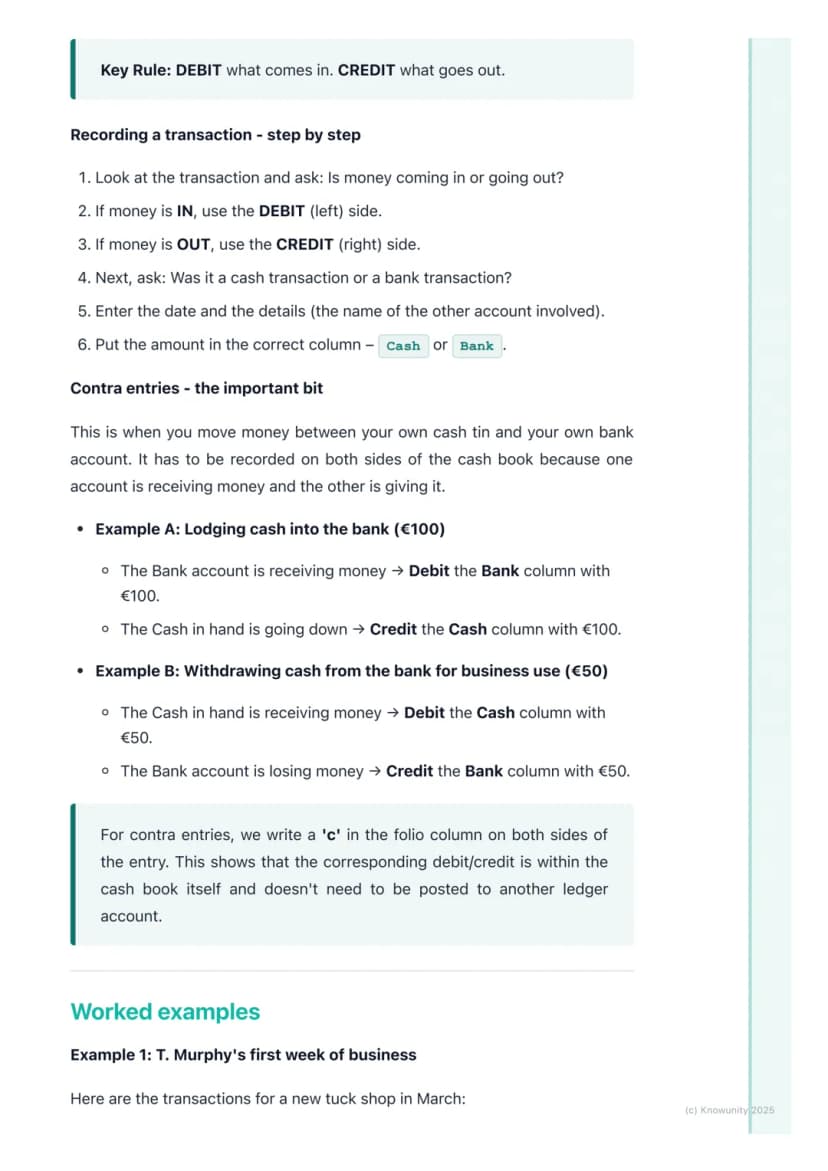
Contra entries are the special ones that trip students up in exams. These happen when you move money between your own cash tin and bank account - like lodging cash into the bank or withdrawing cash for business use.
For contra entries, you must record on both sides of the cash book because one account gains money whilst the other loses it. Always mark these with a 'c' in the folio column - it's an easy exam mark to grab!
Exam Alert: Forgetting the 'c' for contra entries is one of the most common mistakes students make!
4
of 6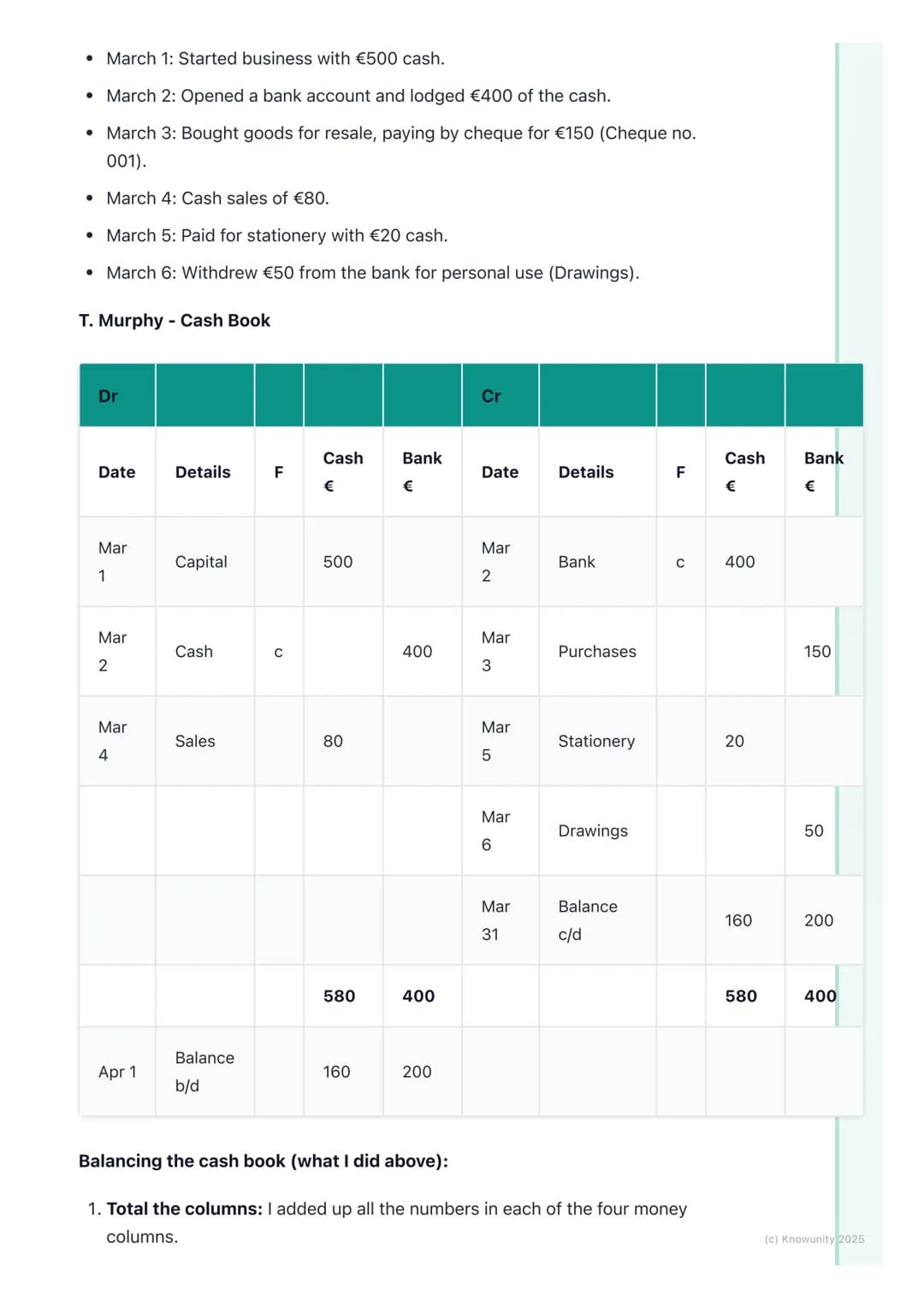
Worked Example - T. Murphy's Tuck Shop
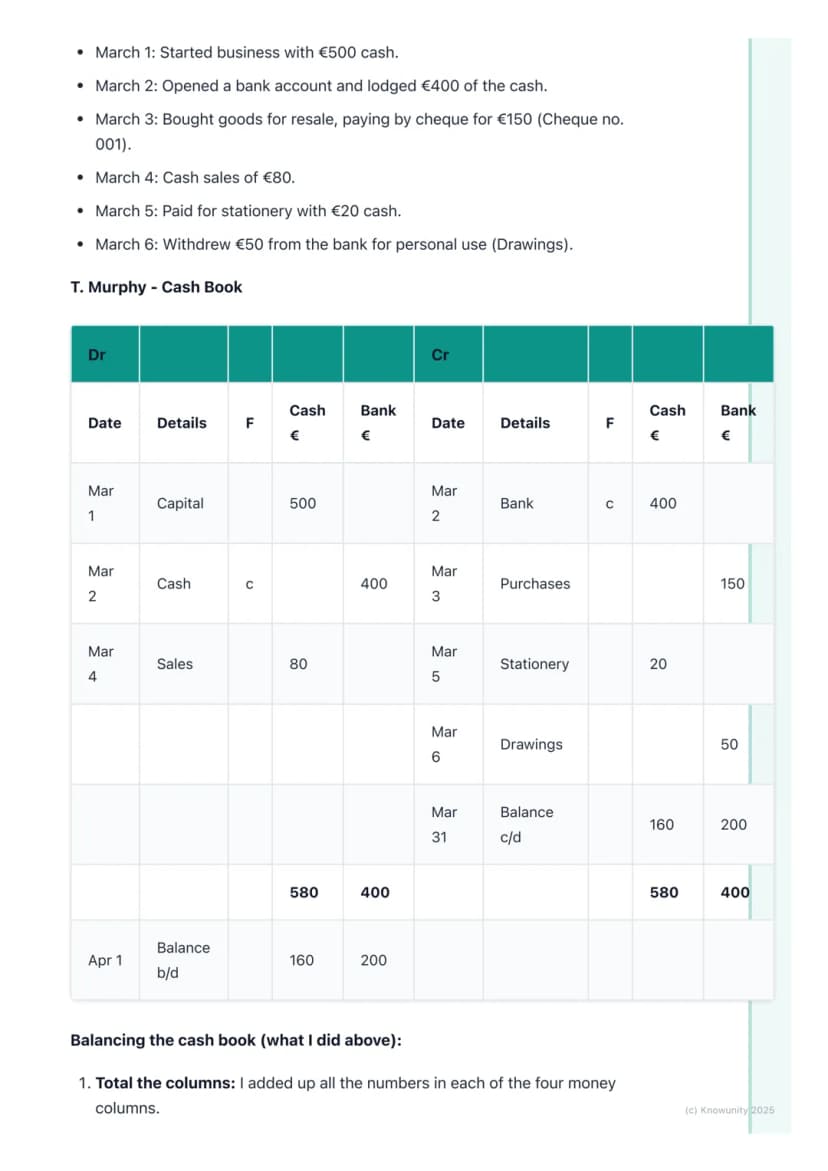
Let's see how this works in practice with T. Murphy's new tuck shop. Starting with €500 cash as capital, Murphy then lodged €400 into the bank - that's a contra entry appearing on both sides.
The purchases of €150 by cheque go on the credit side under bank (money out), whilst cash sales of €80 appear on the debit side under cash (money in). Paying €20 cash for stationery hits the credit cash column, and drawings of €50 from the bank appear in the credit bank column.
Notice how each transaction answers our key questions: Is it money in or out? Is it cash or bank? The contra entry on March 2nd shows 'Bank' on the debit side and 'Cash' on the credit side, both marked with 'c'.
This systematic approach means you'll never get confused about where transactions should go, and your cash book will always tell the complete story of the business's money movements.
Pro Tip: Always double-check your contra entries - they should appear on both sides with identical amounts!
5
of 6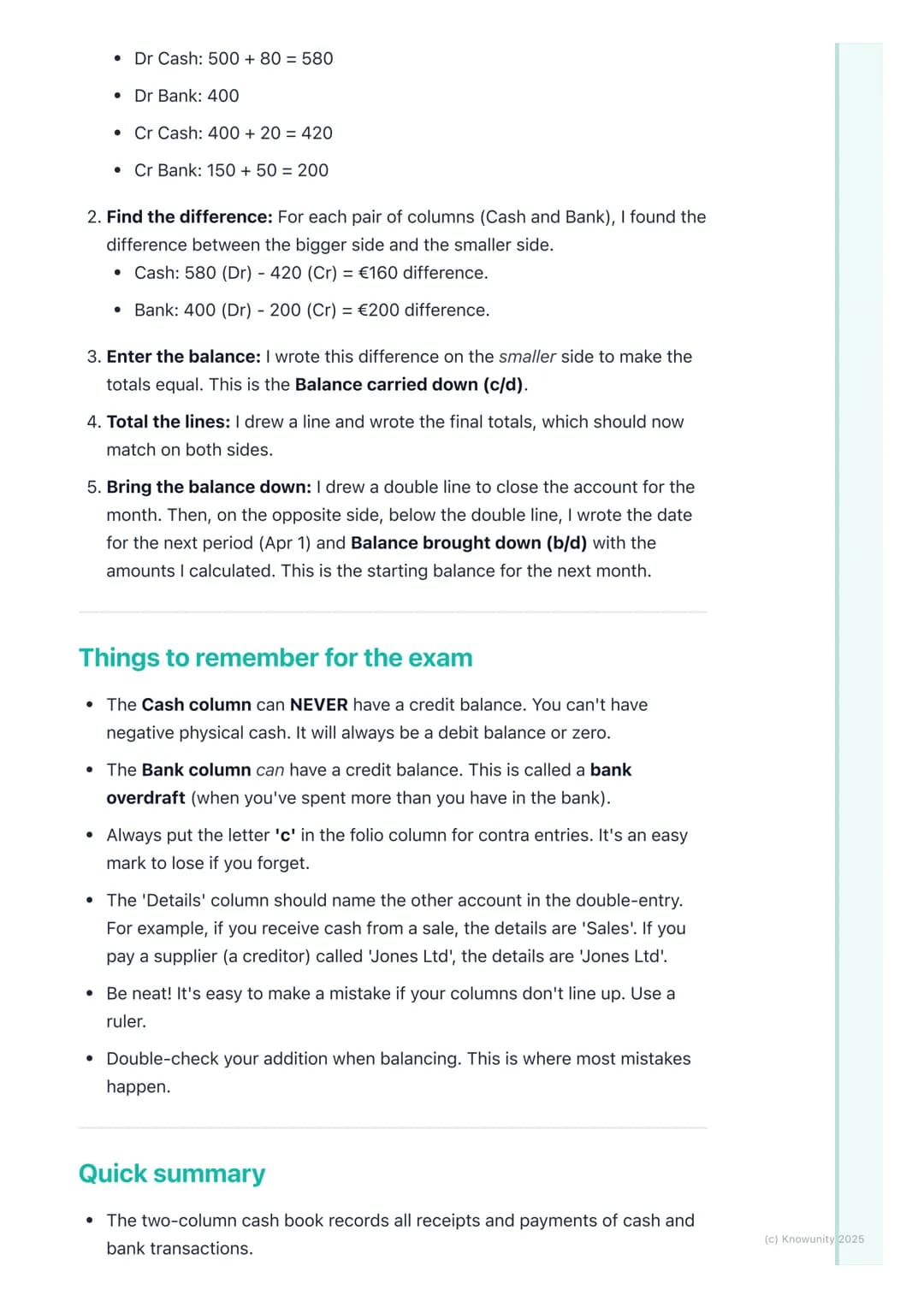
Balancing the Cash Book
Balancing your cash book at month-end is like checking your work - it ensures everything adds up correctly. You'll total each of the four money columns separately, then find the difference between the debit and credit sides for both cash and bank.
The difference represents your closing balance - how much cash and bank money the business actually has. This balance carried down goes on the smaller side to make the totals equal, then gets brought down as balance brought down on the opposite side to start the next period.
In Murphy's example, the cash balance works out to €160 (€580 - €420) and the bank balance to €200 (€400 - €200). These become the opening balances for April, ready for the next month's transactions.
Remember that bank balances can be negative (called an overdraft), but cash balances cannot - you can't have negative physical cash in your till!
Exam Success: Most mistakes happen during balancing, so always double-check your arithmetic!
6
of 6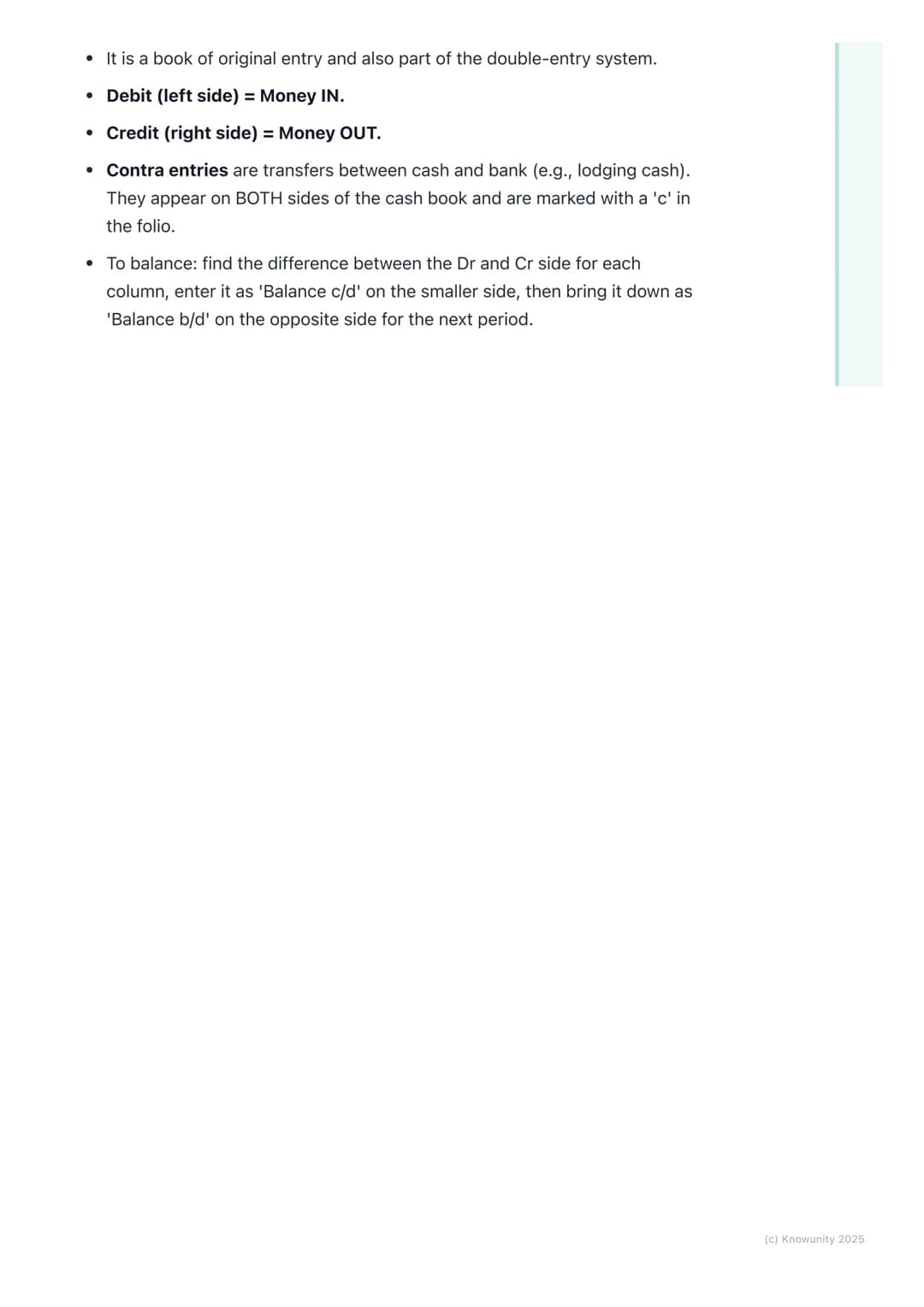
Quick Summary for Exam Success
The two-column cash book combines your cash and bank records into one efficient system that's both a book of original entry and part of the double-entry accounting system. Master the basic rule: debit for money in, credit for money out.
Contra entries are your transfers between cash and bank accounts - they appear on both sides and need that crucial 'c' marking in the folio column. Don't let this easy exam mark slip away!
When balancing, find the difference between debit and credit sides for each column, enter as 'Balance c/d' on the smaller side, then bring it down on the opposite side for the next period. Keep your work neat and your columns lined up.
Practice makes perfect with cash books - the more transactions you work through, the more automatic the process becomes. You've got this!
Final Reminder: Cash balances are always positive, but bank balances can go negative (overdraft situation)!
Mislili smo, da nikoli ne boš vprašal...
Kaj je Knowunity AI spremljevalec?
Naš AI Spremljevalec je orodje umetne inteligence, osredotočeno na dijake, ki ponuja več kot le odgovore. Zgrajen na milijonih virov Knowunity-ja, zagotavlja relevantne informacije, prilagojene načrte učenja, kvize in vsebino neposredno v klepetu ter se prilagaja tvoji individualni poti učenja.
Kje lahko prenesem aplikacijo Knowunity?
Aplikacijo lahko preneseš iz Google Play Store ali Apple App Store.
Je Knowunity res brezplačen?
Tako je! Uživaj v brezplačnem dostopu do učnih vsebin, se povezuj s sošolci in dobi takojšnjo pomoč – vse na dosegu roke.
Najbolj priljubljena vsebina
9 Irish
IrishIrish oral questions and answers
Questions and answers for the leaving cert oral
5th Year4264
 English
Key Quotes : Sive
Key Quotes and explanations: Sive
6th Year2842
IrishIrish oral questions
Outline of oral questions
5th Year2055
IrishIníon- le hÁine Durkin
Aine Durkin’s poem, Iníon: Themes & summary
5th Year890
IrishIrish poetry 2027
Iníon + Dínit an Bhróin
5th Year1153
IrishLC HL notes- Iníon (poem)
Includes poem in English and Irish, theme, key words & phrases
5th Year2304
EnglishCultural Context : Shawshank Redemption : Sive : Small Things Like These
Comparative Study : Cultural Context : Shawshank Redemption, Sive and Small Things Like These
6th Year1430
IrishMo Ghrá-sa (Idir Lúibíní)
Notes on mo ghrá-sa
5th Year380
IrishAn Gaeilge Aiste
Irish Language essay
6th Year1320
Ne najdeš tistega, kar iščeš? Razišči druge predmete.
Dijaki nas obožujejo — in tudi ti boš.
4.6/5App Store
4.7/5Google Play
Aplikacija je res enostavna za uporabo in dobro oblikovana. Našel sem vse, kar sem iskal, in se iz predstavitev ogromno naučil! Aplikacijo bom zagotovo uporabil za razredno nalogo! In seveda mi je tudi super vir navdiha.
Stefan SiOS uporabnik
Ta aplikacija je res kul. Toliko zapiskov za učenje in pomoči [...]. Moj problemski predmet je na primer francoščina, in aplikacija ima toliko možnosti za pomoč. Zahvaljujoč tej aplikaciji sem izboljšal svojo francoščino. Priporočil bi jo vsem.
Samantha KlichAndroid uporabnica
Vau, res sem navdušena. Aplikacijo sem preizkusila, ker sem jo videla oglaševano večkrat, in sem bila popolnoma presenečena. Ta aplikacija je POMOČ, ki jo rabiš za šolo, in ponuja toliko stvari, kot so vaje in povzetki, ki so bili meni osebno ZELO koristni.
AnnaiOS uporabnica
Accounting2 ogledi·Posodobljeno Jun 12, 2026·6 straniThe Two-Column Cash Book Explained
The two-column cash book is your go-to tool for tracking every penny that comes into and goes out of a business. Think of it as a super organised diary that records both physical cash (notes and coins) and bank transactions...
1
of 6
Registriraj se za ogled vsebine. Brezplačno je!
- Dostop do vseh dokumentov
- Izboljšaj svoje ocene
- Pridruži se milijonom študentov
What is a Two-Column Cash Book?
Ever wondered how businesses keep track of all their money? The cash book is like the financial control centre of any business. It's where you first record transactions, making it a book of original entry, but it's also clever enough to be part of the main accounting system (the ledger).
This special book handles both your physical cash and your bank account transactions all in one place. Instead of having separate books for cash and bank money, you get everything organised together - pretty handy, right?
The key thing to remember is simple: debit means money coming IN (left side), and credit means money going OUT (right side). Once you've got this basic rule down, you're halfway there!
Quick Tip: Think of 'debit' as 'deposit' - both start with 'D' and mean money coming in!
2
of 6Registriraj se za ogled vsebine. Brezplačno je!
- Dostop do vseh dokumentov
- Izboljšaj svoje ocene
- Pridruži se milijonom študentov
How the Two-Column Cash Book Works
Picture your cash book like a split screen - identical left and right sides, each with columns for Cash and Bank. The left side (debit) captures all money flowing into the business, whilst the right side (credit) tracks every payment going out.
On the debit side, you'll record things like cash sales, money from customers who owed you, or capital invested by the owner. It's basically your 'income diary' for both cash and bank receipts.
The credit side handles all your outgoings - cash purchases, paying suppliers, rent, electricity bills, and any other business expenses. Whether you pay with physical cash or write a cheque, it all gets recorded here.
The beauty of this system is its simplicity: ask yourself 'Is money coming in or going out?' Then pick the correct side and the right column (cash or bank).
Remember: You can't have negative physical cash, so the cash column will never show a credit balance!
3
of 6Registriraj se za ogled vsebine. Brezplačno je!
- Dostop do vseh dokumentov
- Izboljšaj svoje ocene
- Pridruži se milijonom študentov
Recording Transactions Step by Step
Recording transactions becomes dead easy once you follow this simple process. First, identify whether money is flowing in or out of the business. Then determine if it's a cash transaction (notes and coins) or a bank transaction (cheques, transfers).
For regular transactions, you'll enter the date, write the details (usually the name of the other account involved), and pop the amount in the correct column. For example, if you make cash sales of €80, that goes on the debit side in the cash column with 'Sales' in the details.
Contra entries are the special ones that trip students up in exams. These happen when you move money between your own cash tin and bank account - like lodging cash into the bank or withdrawing cash for business use.
For contra entries, you must record on both sides of the cash book because one account gains money whilst the other loses it. Always mark these with a 'c' in the folio column - it's an easy exam mark to grab!
Exam Alert: Forgetting the 'c' for contra entries is one of the most common mistakes students make!
4
of 6Registriraj se za ogled vsebine. Brezplačno je!
- Dostop do vseh dokumentov
- Izboljšaj svoje ocene
- Pridruži se milijonom študentov
Worked Example - T. Murphy's Tuck Shop
Let's see how this works in practice with T. Murphy's new tuck shop. Starting with €500 cash as capital, Murphy then lodged €400 into the bank - that's a contra entry appearing on both sides.
The purchases of €150 by cheque go on the credit side under bank (money out), whilst cash sales of €80 appear on the debit side under cash (money in). Paying €20 cash for stationery hits the credit cash column, and drawings of €50 from the bank appear in the credit bank column.
Notice how each transaction answers our key questions: Is it money in or out? Is it cash or bank? The contra entry on March 2nd shows 'Bank' on the debit side and 'Cash' on the credit side, both marked with 'c'.
This systematic approach means you'll never get confused about where transactions should go, and your cash book will always tell the complete story of the business's money movements.
Pro Tip: Always double-check your contra entries - they should appear on both sides with identical amounts!
5
of 6Registriraj se za ogled vsebine. Brezplačno je!
- Dostop do vseh dokumentov
- Izboljšaj svoje ocene
- Pridruži se milijonom študentov
Balancing the Cash Book
Balancing your cash book at month-end is like checking your work - it ensures everything adds up correctly. You'll total each of the four money columns separately, then find the difference between the debit and credit sides for both cash and bank.
The difference represents your closing balance - how much cash and bank money the business actually has. This balance carried down goes on the smaller side to make the totals equal, then gets brought down as balance brought down on the opposite side to start the next period.
In Murphy's example, the cash balance works out to €160 (€580 - €420) and the bank balance to €200 (€400 - €200). These become the opening balances for April, ready for the next month's transactions.
Remember that bank balances can be negative (called an overdraft), but cash balances cannot - you can't have negative physical cash in your till!
Exam Success: Most mistakes happen during balancing, so always double-check your arithmetic!
6
of 6Registriraj se za ogled vsebine. Brezplačno je!
- Dostop do vseh dokumentov
- Izboljšaj svoje ocene
- Pridruži se milijonom študentov
Quick Summary for Exam Success
The two-column cash book combines your cash and bank records into one efficient system that's both a book of original entry and part of the double-entry accounting system. Master the basic rule: debit for money in, credit for money out.
Contra entries are your transfers between cash and bank accounts - they appear on both sides and need that crucial 'c' marking in the folio column. Don't let this easy exam mark slip away!
When balancing, find the difference between debit and credit sides for each column, enter as 'Balance c/d' on the smaller side, then bring it down on the opposite side for the next period. Keep your work neat and your columns lined up.
Practice makes perfect with cash books - the more transactions you work through, the more automatic the process becomes. You've got this!
Final Reminder: Cash balances are always positive, but bank balances can go negative (overdraft situation)!
Mislili smo, da nikoli ne boš vprašal...
Kaj je Knowunity AI spremljevalec?
Naš AI Spremljevalec je orodje umetne inteligence, osredotočeno na dijake, ki ponuja več kot le odgovore. Zgrajen na milijonih virov Knowunity-ja, zagotavlja relevantne informacije, prilagojene načrte učenja, kvize in vsebino neposredno v klepetu ter se prilagaja tvoji individualni poti učenja.
Kje lahko prenesem aplikacijo Knowunity?
Aplikacijo lahko preneseš iz Google Play Store ali Apple App Store.
Je Knowunity res brezplačen?
Tako je! Uživaj v brezplačnem dostopu do učnih vsebin, se povezuj s sošolci in dobi takojšnjo pomoč – vse na dosegu roke.
Najbolj priljubljena vsebina
9IrishIrish oral questions and answers
Questions and answers for the leaving cert oral
5th Year4264
EnglishKey Quotes : Sive
Key Quotes and explanations: Sive
6th Year2842
IrishIrish oral questions
Outline of oral questions
5th Year2055
IrishIníon- le hÁine Durkin
Aine Durkin’s poem, Iníon: Themes & summary
5th Year890
IrishIrish poetry 2027
Iníon + Dínit an Bhróin
5th Year1153
IrishLC HL notes- Iníon (poem)
Includes poem in English and Irish, theme, key words & phrases
5th Year2304
EnglishCultural Context : Shawshank Redemption : Sive : Small Things Like These
Comparative Study : Cultural Context : Shawshank Redemption, Sive and Small Things Like These
6th Year1430
IrishMo Ghrá-sa (Idir Lúibíní)
Notes on mo ghrá-sa
5th Year380
IrishAn Gaeilge Aiste
Irish Language essay
6th Year1320
Ne najdeš tistega, kar iščeš? Razišči druge predmete.
Dijaki nas obožujejo — in tudi ti boš.
4.6/5App Store
4.7/5Google Play
Aplikacija je res enostavna za uporabo in dobro oblikovana. Našel sem vse, kar sem iskal, in se iz predstavitev ogromno naučil! Aplikacijo bom zagotovo uporabil za razredno nalogo! In seveda mi je tudi super vir navdiha.
Stefan SiOS uporabnik
Ta aplikacija je res kul. Toliko zapiskov za učenje in pomoči [...]. Moj problemski predmet je na primer francoščina, in aplikacija ima toliko možnosti za pomoč. Zahvaljujoč tej aplikaciji sem izboljšal svojo francoščino. Priporočil bi jo vsem.
Samantha KlichAndroid uporabnica
Vau, res sem navdušena. Aplikacijo sem preizkusila, ker sem jo videla oglaševano večkrat, in sem bila popolnoma presenečena. Ta aplikacija je POMOČ, ki jo rabiš za šolo, in ponuja toliko stvari, kot so vaje in povzetki, ki so bili meni osebno ZELO koristni.
AnnaiOS uporabnica